Friday, September 22, 2006

Pope invites Islamic diplomats

read article
The pontiff will open the doors of his summer residence, Castel Gandolfo, to the ambassadors and members of the Italian Islam Consulta, according to ANSA, an Italian news agency. The Islam Cosulta is a council of the various Muslim community leaders in Italy who meet periodically with Italian government officials.

"The purpose of this meeting is to relaunch dialogue with the Islamic world," a senior Vatican official said on Friday.

Islamic diplomats accredited to the Holy See said they hoped the meeting would help restore trust between the Roman Catholic Church and Muslims angered by the pope's speech last week in Germany.

"We welcome it and are definitely going to participate," Iran's deputy ambassador to the Holy See, Ahmad Faihma, told Reuters.

"This is a positive signal from the Vatican. I know that this will improve relations with the Islamic world."

"This meeting will be very important, especially in these days, to try to stop every action that is not good," Fathi Abuabed, head of international relations at the Arab League's Vatican mission, told the agency.

John Allen's All things Catholic


Fall out from Benedict's comments on Islam; What's next for Christian-Muslim relations? click here for article

John Allen is one of the few religious commentators that should be taken seriously in this weeks column he speaks about Benedict and the Bush regime, Islam and Zionism. He dismisses the rather facile suggestions many have made recently about Benedict.

Jews preparing for New Year


According to the Torah, God created the world and the first human being precisely 5767 years ago.

Benedict: A Brief Analysis

Fr Guy Selvester has an interesting take on getting rid of the tiara from the pope’s coat of arms, something shocking for many traddies, a great sign of liberalism for others.

No longer is the Pope to be seen as monarch but as a bishop, a teacher of the Catholic faith, a leader of Christians, a sanctifier of men (yes, and women too, as well as children). We saw and we did not understand, here was a sign from someone often described as a “liturgist”, someone for whom signs and symbols (and words) are important.

If the panoply of sovereignty are gone, then what about the structures that support it? Well gone too is the Cardinal Sodano the diplomat replaced by a theologian, gone too is Archbishop Fitzgerald, the Islamic expert, gone with them is the spirit of rapprochement.


What has replaced it? I believe a papacy dedicated to the simply revealing the truth that Jesus is Lord. The most significant document of this Papacy was issued in 2000 Dominus Jesus, by the then Cardinal Ratzinger. Benedict believes with every fibre of his being that the world needs Jesus the Lord. He actually believes what he said in his Regensburg lecture that God is rational and communicates Himself through human reason. He sees the problems of the world coming from the rejection Truth, ultimately the rejection of Christ. Thus the triumph of Islam over the Byzantine Empire is indeed evil, for it is about Christ being replaced by something that lacks ultimate Truth.

In his struggle against Liberation theology, it wasn’t the idea of Christianity standing alongside the poor that worried him, far from it, it was the fusion of Christ and Marx, therefore the confusion of the Christian message, the blurring of Truth that caused him such concern.

In his books on the Liturgy, he argues that post Vatican II liturgy removes the image of Christ from its central position on the altar and replaces it with the priest. For Him the centrality of Christ is the only important thing. His ideal is that the Church, and the world, is re-orientated towards Christ and revealing Him with clarity.

His vision is one that is sharply Christo-centric, in his Regensburg address it is not merely Islam that should have drawn a sharp intake of breath but secularism and Protestant fundamentalism and liberalism, but above all Catholic Liberalism, for it is Christ presented in it His awesome clarity that is important to him, without the veils of modern philosophy that obscure his true image.

For the Church the Benedictine years are going to become increasingly exciting, for his constant invitation is to turn towards Christ and to reveal Him to the world.

For Benedict, Christ who is the Truth is discovered, or even revealed, in many different ways but only partially; ultimately Christ the Truth can be known fully only within mainstream Christianity, which is identified in Dominus Jesus as the One, Holy, Catholic and Apostolic Church.

Something nice


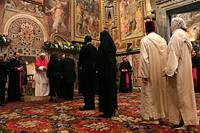
The pictures start of with the legend of St Joseph, the birth the Virgin etc.

What more could he do?


from Christianity Today
All apologies:

For 4th time, Pope clarifies Islam remark Many non-Muslims, though, said they were glad the pope spoke out about violence and Islam (The New York Times)

Pope says remarks on Islam misunderstood During an audience in a tightly guarded St. Peter's Square, Benedict acknowledged that his comments — which sparked fury across the Muslim world — were open to misinterpretation (Associated Press)

Pope tries again to calm furor among Muslims Pope Benedict XVI on Wednesday expressed "a deep respect" for Islam, but again chose not to apologize outright for remarks last week that sparked worldwide Muslim anger (USA Today)

Pope, in new step to end crisis, pays respect to Islam The pontiff uses a general audience in St. Peter's Square to again reassure Muslims after his words last week provoked their fury (Los Angeles Times)

In a rare step, Pope expresses personal regret Church experts said it appeared to be the first time a pope has made such a direct apology (The New York Times)

Earlier: Vatican says Pope Benedict regrets offending Muslims The Vatican statement stopped short of the direct personal apology from Benedict that many Muslims have been demanding (The New York Times)

Saturday: Some Muslim leaders want Pope to apologize Muslim leaders around the world accused Pope Benedict XVI of dividing religions in comments he made Tuesday about Islam (The New York Times)

Pope apologies: 'Medieval text does not express my personal thought' This crisis aside, Benedict does have a more hawkish approach to Islam than Pope John Paul II (John L. Allen, Jr., National Catholic Reporter)

Mixed reaction as pope expresses regret Pope Benedict XVI said Sunday that he is "deeply sorry" his remarks on Islam and violence offended Muslims, but the unusual expression of papal regret drew a mixed reaction from Islamic leaders as the Vatican worried about a backlash of violence (Associated Press)

Pope 'sorry' about reaction to Islam remark (The Washington Post)

Pope issues a rare 'sorry' Benedict XVI publicly apologizes over the reaction to his citation of material that faults Islam. Muslims say it doesn't go far enough (Los Angeles Times)

Vatican tries to calm Pope row Al Qaeda militants in Iraq vowed war on "worshippers of the cross" and protesters burned a papal effigy on Monday over Pope Benedict's comments on Islam, while Western churchmen and statesmen tried to calm passions (Reuters)

Apologies issued during John Paul papacy Some instances in which Pope John Paul II admitted errors or apologized for actions of the Roman Catholic Church (Associated Press)

Pope expresses 'deep respect' for Islam Pope Benedict XVI said Wednesday that he has "deep respect" for Islam, but he did not offer an apology demanded by some Muslim leaders offended by the pontiff's remarks in Germany last week (Associated Press)

Pope says anti-Islam quotes not his own views Pope Benedict said on Wednesday that his use of medieval quotes portraying a violent Islam did not reflect his views and were misunderstood, but he did not give the clear apology still demanded by many Muslims (Reuters)

Pope hopes that controversy will lead to dialogue The Pope today described the worldwide Muslim anger that has engulfed his recent remarks about Islam as the result of an "unfortunate misunderstanding" (The Times, London)

WAR PORN: U.S. Military’s Other Problem in Iraq

by PATRICK NOVECOSKY
National Catholic Register

BAGHDAD, Iraq — Pornography in the military has been a problem for decades. But not like today.
During World War II, GIs carried decks of cards illustrated with naked women and posted photos of “pin-up gals” Betty Grable and Rita Hayworth.
The Iraq War at its most extreme had Abu Ghraib and its photos of naked Iraqi prisoners.
Catholic author Patrick Madrid said his first thought on seeing the photos was that Americans shouldn’t be surprised: “The pornography chickens are coming home to roost.”
Today, pornography is sold at most base exchanges (BXs) in the United States. It’s part of a $57-billion-a-year worldwide industry. Porn revenue is larger than the combined revenues of all professional football, baseball and basketball franchises, according to the Internet Filter Review. In the United States, revenue from pornography ($12 billion a year) far exceeds the combined revenues of the three major television networks — ABC, CBS and NBC ($6.2 billion).
In Iraq, alcohol and pornography — including Internet porn — are banned for enlisted personnel out of sensitivity to adherents of the country’s dominant religion, Islam. But despite the prohibitions and blocking software on military computers, Father Mark Reilly, who served as a marine chaplain in Iraq this year, said increasing numbers of both men and women serving in Iraq have access to porn, and have become addicted.
“I don’t think I’ve ever been confronted as much face-to-face with men and women — in and out of the confessional — saying, ‘I’m addicted to porn and I don’t know how to get out of it,’” Father Reilly said. “They’re looking for a life preserver. It’s wrecking their marriages. Like any addiction, they lose control.”
British historian Joanna Bourke said that at their worst, pornography causes imitative behavior like the Abu Ghraib photos — made by and for porn addicts. “The abuse is performed for the camera,” she wrote in the Guardian. “These obscene images have a counterpart in the worst, non-consensual sadomasochistic pornography.
Rochelle Gurstein in The New Republic said that the Abu Ghraib photos “speak to the coercive and brutalizing nature of the pornographic imagination so prevalent in our world today.”
The conditions soldiers must endure make them more susceptible to porn addiction, said Steve Wood, president of the Family Life Center in Port Charlotte, Fla.
Wood, a convert who has written about breaking addiction to porn, said the worst conditions to fuel an addiction are stress, isolation from family and sleep deprivation.
“If some Marine was out there on the front lines and got wounded, vast resources of the United States would be mobilized to bring him to health,” he said. “Here, he’s in mortal sin, which endangers not the body, but the soul for eternity, and he’s suffering in silence. These guys are hurting — good guys who want to be good Catholic men and husbands and fathers — but get hooked on this and can’t find their way out.”
Archbishop Edwin O’Brien, who leads the U.S. military archdiocese, told the Register that chaplains’ guidance in and out of the confessional is invaluable.
“They can counsel — whether it’s one-on-one or whether it’s in the sacramental realm,” he said. “But chaplains have the added opportunity to speak publicly about it and form policy. They have access to the commander, who sets regulations, and I think most commanders are leery of the spread of pornography.”
Chaplains can help influence “what is sold in the BX, what’s allowed in a public space, an office or a barracks, and I think a chaplain can have great leverage here,” the archbishop said.
Wood, who served in the Navy during the late ’60s, said most pornography addicts have internal scars — usually from childhood.
“High numbers of people — both men and women — involved in pornography have been sexually abused as children,” he explained. “It could be an oppressive, cruel father or abuse when they were young, a breakup of parents’ marriage — the type of thing that could cause depression and/or internal struggles in any average person.
“When you start dabbling in pornography, it becomes like an aspirin relieving that internal pain,” he said. But a stronger dose of pornography will be necessary to “medicate” the next time.
The key to breaking the addiction, he said, is to first go to confession, then seek professional counseling for the internal pain and the addiction.
The Catechism of the Catholic Church teaches that any association with pornography is a grave sin. “It does grave injury to the dignity of its participants (actors, vendors, the public), since each one becomes an object of base pleasure and illicit profit for others. It immerses all who are involved in the illusion of a fantasy world. It is a grave offense” (No. 2354).
Barry Marteson is so ashamed of his own pornography use that he didn’t want his real name used for this story.
“It’s humiliating and certainly one of the seven deadly sins,” said the Catholic former Marine.
Marteson was a child when he began looking at discarded magazines his father owned. Being a Marine in the 1970s didn’t help.
“Some of the guys just got back from Guantanamo Bay and were talking about ‘how great the chicks were’ down there,” he said. “All these guys were 18 and I’m 23. I knew better, but I like to be one of the boys, so we would get drunk and go out to the X-rated film parlors” and strip clubs.
Now Marteson’s son is serving in Iraq and is also dealing with pornography addiction. Marteson finally reached a point where he knew he needed help.
“It became really obvious five years ago that it’s bigger than me,” he said. “I was getting it in the house over the Internet and it was truly addictive to the point where I’m panicked. I’m screaming and I’m crying.”
After years of going to confession and spiritual counseling, he says he’s having some success. After a recent trip to the airport, he had some time to kill in an area where he used to frequent strip clubs. When he made it home without stopping, he said he knew he was on the right path.
“It was hardly worth writing home about, but I put a note in my book about it,” he said. “It’s grace. There was an incredible amount of grace. I don’t know that I want to cry, but I just feel giddy!”
The Lord’s descent into the underworld

At Matins/the Office of Readings on Holy Saturday the Church gives us this 'ancient homily', I find it incredibly moving, it is abou...