Showing posts with label Ecumenism. Show all posts

Monday, December 04, 2006


Some interesting words from an exclusive interview of Patriarch Bartholomeus with the semi-official daily of the Italian Episcopal Conference, Avvenire:
This morning's speeches and the joint declaration that you have undersigned sounded "lofty" and certainly promising. You have even spoken of the future, regarding the [future] steps?Regarding this, I can say that I have spoken to His Holiness about something, something we can do. I have made him an offer that I cannot yet talk about, while we wait for an official response in this sense; however, I can say that His Holiness displayed great interest and welcomed the offer favorably. We hope that it can be accomplished, because it truly follows the prospects of that ecumenical progress which, as we have affirmed and even written in the Joint Declaration, we both are determined to pursue.


I wonder could mean?

Wednesday, November 29, 2006

More from Istambul


The pope expressed his great joy at the encounter and said he would treasure the Orthodox welcome forever.

"I thank the Lord for the grace of this encounter, so filled with authentic good will and ecclesial significance," he said.

"May this meeting strengthen our mutual affection and renew our common commitment to persevere on the journey leading to reconciliation and the peace of the churches," he said.

The evening prayer service in Istanbul Nov. 29 opened two days of richly symbolic events and brought an ecumenical focus to the pope's four-day visit to Turkey.


Patriarch Bartholomew, who is honored as the "first among equals" in the Orthodox world, greeted the pope at the Istanbul airport and met him again shortly afterward on the steps of the patriarchate's headquarters, where dozens of Orthodox prelates were waiting in the Church of St. George.

The pope and patriarch lit votive candles and, as applause rang out, walked up the center aisle, their path clouded with incense. A choir chanted antiphons commemorating Sts. Peter and Paul, the patron saints of Rome, and St. Andrew, the patron of the patriarchal see of Constantinople, the ancient name of Istanbul.

The pope, wearing a red cape against the chill, looked good after a day that took him from the capital city of Ankara to the ancient site of Ephesus for a Mass, and finally to Istanbul.

The pope and patriarch listened to a reading of the prophet Zechariah, calling the peoples of East and West to assemble again in Jerusalem. After praying the Our Father, they each gave short talks.

The pope spoke of the ancient Christian roots of the region and cited "the rich harvest of martyrs, theologians, pastors, monastics, and holy men and women which those churches brought forth over the centuries."He also recalled the ecumenical milestones of recent years, including the decision of both churches in 1965 to lift the excommunications exchanged in 1054 which marked the beginning of the East-West schism.At that time, the pope said, Pope Paul VI and Patriarch Athenagoras announced their ecumenical breakthrough in a "spirit of rediscovered love."

"It is on this foundation of mutual love that new relations between the churches of Rome and Constantinople have developed," he said. The signs of that love, he said, include visits of Popes Paul and John Paul II, in 1967 and 1979, respectively, to the ecumenical patriarchate.Patriarch Bartholomew also recalled the visits of previous popes, saying these men understood the "inestimable value and urgent need" of such encounters.

"We are deeply grateful to God that Your Holiness has taken similar steps today in the same spirit," the patriarch said.The pope and patriarch stopped briefly to venerate the relics of St. Gregory Nazianzen and St. John Chrysostom, both former patriarchs of Constantinople. Pope John Paul returned a portion of the relics to Patriarch Bartholomew in 2004; they were believed stolen from Constantinople during the Crusades in 1204.

Patriarch Bartholomew recalled warmly the late pope's gesture.

Pope arrives in Istanbul

POPE Benedict XVI arrived today in Istanbul, the final stop of his four-day trip to Turkey, after celebrating his first mass on Muslim soil in the historic western city of Ephesus.
The pontiff was met at the airport by Bartholomew I, head of the Greek Orthodox Church, as well as Armenian Patriarch Mesrob II and Syriac Patriarchal Vicar Filuk.
Benedict was to hold talks later with Bartholomew I in his quest for rapprochement between Christianity's Eastern and Western rites, estranged for nearly 1000 years.


Welcome by His All Holiness Ecumenical Patriarch Bartholomew to His Holiness Pope Benedict XVI After the Prayer Service at the Patriarchal Cathedral of St. George
Your Holiness, beloved Brother in the Lord,
It is with sentiments of sincere joy and satisfaction that we welcome you to the sacred and historical city of Istanbul.
This is a city that has known a treasured heritage for the growth of the Church through the ages. It is here that St. Andrew, the "first-called" of the Apostles founded the local Church of Byzantium and installed St. Stachys as its first bishop. It is here that the Emperor and "equal-to-the-Apostles," St. Constantine the Great, established the New Rome. It is here that the Great Councils of the early Church convened to formulate the Symbol of Faith. It is here that martyrs and saints, bishops and monks, theologians and teachers, together with a “cloud of witnesses” confessed what the prophets saw, what the apostles taught, what the church received, what the teachers formulated in doctrine, what the world understood, what grace has shone, namely…the truth that was received, the faith of the fathers. This is the faith of the Orthodox. This faith has established the universe.
So it is with open embrace that we welcome you on the blessed occasion of your first visit to the City, just as our predecessors, Ecumenical Patriarchs Athenagoras and Demetrios, had welcomed your predecessors, Popes Paul VI and John Paul II. These venerable men of the Church sensed the inestimable value and urgent need alike of such encounters in the process of reconciliation through a dialogue of love and truth.
Therefore, we are, both of us, as their successors and as successors to the Thrones of Rome and New Rome equally accountable for the steps - just, of course, as we are for any missteps - along the journey and in our struggle to obey the command of our Lord, that His disciples "may be one."
It was in this spirit that, by the grace of God, we visited repeatedly Rome and two years ago in order to accompany the relics of Saints Gregory the Theologian and John Chrysostom, formerly Archbishops of this City, whose sacred remains were generously returned to this Patriarchal Cathedral by the late Pope. It was in this spirit, too, that we traveled to Rome only months later to attend the funeral of Pope John Paul.
We are deeply grateful to God that Your Holiness has taken similar steps today in the same spirit. We offer thanks to God in doxology and express thanks also to Your Holiness in fraternal love.
Beloved Brother, welcome. "Blessed is he that comes in the name of the Lord."
"Blessed is the Name of the Lord now and forevermore."

Thursday, November 23, 2006

Serious Obstacles

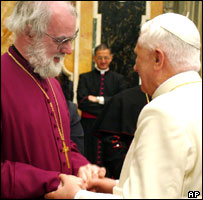
VATICAN CITY, NOV. 23, 2006 (Zenit.org).- Here is the address Benedict XVI delivered today during his audience to the primate of the Anglican Communion, Archbishop Rowan Williams of Canterbury, England.

Your Grace, Dear friends,
Grace and peace to you in the Lord Jesus Christ! Your visit here today brings to mind the important custom established by our predecessors in recent decades. It also reminds us of the much longer history of relations between the See of Rome and the See of Canterbury which began when Pope Gregory the Great sent Saint Augustine to the land of the Anglo-Saxons over 1400 years ago. I am happy today to welcome you and the distinguished delegation accompanying you. This is not our first meeting. Indeed, I was grateful for your presence, and that of other representatives of the Anglican Communion, at the funeral of Pope John Paul II, and again at the inauguration of my pontificate a year and a half ago. Your visit to the Holy See coincides with the fortieth anniversary of the visit of the then Archbishop of Canterbury, Dr Michael Ramsey, to Pope Paul VI. It was a visit filled with great promise, as the Anglican Communion and the Catholic Church took steps towards initiating a dialogue about the questions to be addressed in the search for full visible unity. There is much in our relations over the past forty years for which we must give thanks. The work of the theological dialogue commission has been a source of encouragement as matters of doctrine which have separated us in the past have been addressed. The friendship and good relations which exist in many places between Anglicans and Catholics have helped to create a new context in which our shared witness to the Gospel of Jesus Christ has been nourished and advanced. The visits of Archbishops of Canterbury to the Holy See have served to strengthen those relations and have played an important role in addressing the obstacles which keep us apart. This tradition helped give rise to a constructive meeting of Anglican and Catholic bishops in Mississauga, Canada, in May 2000, when it was agreed to form a joint commission of bishops to discern appropriate ways to express in ecclesial life the progress which has already been made. For all of this, we give thanks to God. In the present context, however, and especially in the secularized Western world, there are many negative influences and pressures which affect Christians and Christian communities. Over the last three years you have spoken openly about the strains and difficulties besetting the Anglican Communion and consequently about the uncertainty of the future of the Communion itself. Recent developments, especially concerning the ordained ministry and certain moral teachings, have affected not only internal relations within the Anglican Communion but also relations between the Anglican Communion and the Catholic Church. We believe that these matters, which are presently under discussion within the Anglican Communion, are of vital importance to the preaching of the Gospel in its integrity, and that your current discussions will shape the future of our relations. It is to be hoped that the work of the theological dialogue, which had registered no small degree of agreement on these and other important theological matters, will continue [to] be taken seriously in your discernment. In these deliberations we accompany you with heartfelt prayer. It is our fervent hope that the Anglican Communion will remain grounded in the Gospels and the Apostolic Tradition which form our common patrimony and are the basis of our common aspiration to work for full visible unity.
The world needs our witness and the strength which comes from an undivided proclamation of the Gospel. The immense sufferings of the human family and the forms of injustice that adversely affect the lives of so many people constitute an urgent call for our shared witness and service. Precisely for this reason, and even amidst present difficulties, it is important that we continue our theological dialogue. I hope that your visit will assist in finding constructive ways forward in the current circumstances. May the Lord continue to bless you and your family, and may he strengthen you in your ministry to the Anglican Communion!
[Original text: English] © Copyright 2006 -- Libreria Editrice Vaticana


Monday, October 16, 2006

A New Understanding of Communion????

Fr Sean has an interesting post on the implications of the extension of the Classical Roman Rite, which he found in the Scotsman. Bishop Fellay, the leader of the presently schismatic Society of Saint Pius X, has been talking about an accommodation with the Church similar to what exist in China with the "Patriotic Church", this I find interesting because this could well be a model for reunion with the Orthodox.
He says, "We would be a bit like the Chinese Patriotic Church, in the Church without really being there," he explained. "There could be a relationship between Rome and us, but it would not yet be a juridical relationship."
At the moment the "Patriotic Church" seems to exist in partial communion, its lay members and its priests seem to move freely between this government sponsored Church and the partially tolerated Catholic Church. The Bishops of the Patriotic Church, when named by the state seek approval from Rome, before ordination. Under Pope John Paul II Rome almost always accepted their nomination, under Benedict this has happened less often and those Bishop's ordained without Rome's permission incur automatic excommunication and have not been accepted by the vast majority of the people or the clergy. Cardinal Zen has recently spoken about significant, "85% reconciliation of the Patriotic Church", with the Church.
The problem with the SSPX is that there are more issues than simply the celebration of the ancient Mass, there is the whole matter of the authority of the Second Vatican Council, religious freedom and so forth. SSPX is in schism, though in so many areas at one with the Catholic Church. Except for a lunatic fringe, it earnestly seeks full and visible communion with the successor of Peter. There has been lots of talk in Rome about re-establishing communion and then sorting out these other matters afterwards.
The Orthodox Church is in similar position, though possibly less earnest about full communion. The Great Schism, in the 11th Century, in many ways did little to alter the relationship between the laity and the lower clergy until the nineteenth century and the declaration on infallibility. In many places Catholic priests acted as confessors to Orthodox nuns, lay people received the sacraments from either Catholic or Orthodox priests, the major effect was that on substantial matters of disagreement Rome was no longer the last recourse, though in theory the canons of the Greek Church still have the Pope as the ultimate source of judgement.
There is something radical about the theology of Pope Benedict, he is totally at one with the Traditional of the the Church and like the good scribe is able to bring out from his treasury things both old and new. It seems to me that he is seeking a new understanding of the very nature of communion.
We live in theologically exciting times. It would be glorious if solution to the Patriotic Church, the Lefebrvists and the re-union with the Orthodox could actually be the sorted out substantially this November, remember this November not only do we expect a declaration on the Tridentine Rite but also the visit the Constantinople. Everything I read by our pope, makes me think that he has the subtlety of mind to set in train such a reconcilliation.

Friday, September 29, 2006

Patriarch of Constantinople speaks


Ecumenical Orthodox Patriarch Bartholomew of Constantinople speaks about the Popes forthcoming visit to Istanbul, religious freedom and there is a little about the Turkish state control (persecution) of the Orthodox Church Turkey as well as a snippet about thre Orthodox- Catholic talks in Belgrade.

"In general, the pope is awaited in Turkey with joy and love," he said. He added that he was certain the government would take all necessary security measures to guarantee the pope's safety during the visit. Patriarch Bartholomew met with reporters the day after the European Union pressed the Turkish government to take several steps to respect the rights of religious minorities. Turkey is trying to enter the European Union, and Orthodox church officials are hoping that process will help expand religious freedom in the country.


The patriarch ends by speaking of the recent theological encounter in Belgrade, Serbia-Montenegro, opened the way for a discussion on papal primacy, long considered one of the most difficult ecumenical issues. Metropolitan John of Pergamon, Orthodox co-chairman of the international Catholic-Orthodox theological dialogue commission, told the reporters that Orthodox representatives to the dialogue have somewhat divergent views on papal primacy. Because they represent 15 Orthodox churches, he said, they do not feel they have to assume a unified position."Of course, the Roman Catholic Church is more disciplined, more organized, more obedient. We are more ...," he said, pausing to find the right word."Democratic," Patriarch Bartholomew said with a laugh, completing his sentence for him.
read whole article

Saturday, September 23, 2006

Rebel Greek monks face jail


Anti-Catholic monks, their slogan "Orthodox or Death, are being prosecuted by Greek authorities, having been declared schismatic by the Ecumenical Patriarch of Constantinople.


link to bbc video

The Lord’s descent into the underworld

At Matins/the Office of Readings on Holy Saturday the Church gives us this 'ancient homily', I find it incredibly moving, it is abou...