Showing posts with label monastic communities. Show all posts

Sunday, November 19, 2006

Angelus on Contemplatives


Vatican City (AsiaNews) – The day for those who pray, which is celebrated on 21 November, the commemoration of the Presentation of Mary in the Temple, is traditionally dedicated to remembering cloistered religious communities. The value of this day and of cloistered life itself were at the heart of the reflection of Benedict XVI before today’s Angelus, delivered to tens of thousands of faithful gathered in St Peter’s square.
This day is an “opportunity, as timely as ever, to thank the Lord for the gift of so many people who, in monasteries and hermitages, dedicate themselves totally to God in prayer, silence and seclusion.” The pontiff appealed that “our spiritual and even material support” to such cloistered communities, male and female, will not fall short, “so that they may fulfill their mission of keeping alive in the Church the ardent expectation of the return of Christ.”
The pope said that in our time, “there are not a few people who leave their professional, often promising careers, often to the surprise of friends and acquaintances, to embrace the austere, regulated life of a cloistered monastery.”
Benedict XVI cited many objections that abound in society about such vocations: “Some ask what meaning and value their presence could have in our time, when there are numerous and urgent situations of poverty that need to be tackled.” Why “close yourself” forever within the walls of a monastery and thus deprive others of the contribution of your capabilities and experience? What effectiveness could your prayers have for the solution of so many problems that continue to afflict humanity?”
The pope showed that behind apparent futility, there lay a great, effective witness for believers and non believers. Above all, people who embrace the cloistered life have understood that the “Kingdom of the heavens is a ‘treasure’ which it is well worth giving up everything for (cfr Mt 13:44)? In effect, these brothers and sisters of ours testify silently that in the midst of daily life, at times rather tortuous, the only support that never vacillates is God, the unshakeable rock of faithfulness and of love. “Todo se pasa, Dios no se muda”, wrote the great spiritual teacher, St Teresa d’Avila, in a renowned text.”
In the second place, cloistered monasteries “apparently futile, are really indispensable, like the green ‘lungs’ of a city: they do good to all, even those who do not visit them and who perhaps ignore their existence.” And this is why there is the “widespread need” to “leave the daily routine of large urban cities in search of propitious places of silence and meditation, of monasteries of contemplative life that are like an ‘oasis’ in which man, pilgrim on earth, can better draw from the source of the Spirit and quench himself along the way.”
The pope concluded his reflection by reiterating “thanks to the Lord, who is his providence, brought about cloistered communities, male and female”, asking for them and for all, “the intercession of Mary who, in commemorating her Presentation in the Temple, we will contemplate as Mother and model of the Church, who unites in her both vocations: to virginity and to matrimony, to contemplative as well as to active life.”

Monday, September 25, 2006

Die Grosse Stille (Into Great Silence) trailer

German director Philip Gröning was allowed to film life inside the Grande Chartreuse, the mother house of the Carthusian Order in the French Alps. A breathtaking film, using mainly the silence as a soundtrack, has drawn large audiences in Germany and an increased interest Christian asceticism.

Thursday, September 14, 2006

St Cecelia's Abbey, Ryde, Isle of Wight


I used to say Mass, occassionally, for these nuns in their rather austere Church. Have a look at their website, they are known for their erudition, their chant, of which there are lots of recordings available. You could also look out books by Sr Mary David Totah OSB, especially Undivided Heart: Another Look at Enclosure (not on Amazon). On their website there is a very interest faq section I was struck by this:

Why do you still have your liturgy in Latin?
We always have the Mass readings in English, and on Sundays and other days when there’s a large congregation we have the prayers in English too. In the Divine Office we have the Patristic readings in English. We made a deliberate choice to keep the rest in Latin for several reasons. First, the Gregorian Chant which we use for all our liturgy was composed for Latin texts. The melodies weren’t written first and then the words fitted to them; the melodies were made for the existing texts (almost all quotations from Scripture). We couldn’t use the same melodies for English words, and they’re so subtle and beautiful that to adapt them would be to spoil them. These chants evolved from the music of the synagogues which the first Christians adopted, and developed over more than a thousand years. There’s often a theology in the melody itself - for example, as it becomes more elaborate at the important words or phrases. Then, all the great monastic figures in the western Church wrote in Latin and it’s good to keep in touch with them. Often we’re singing chants which they would have known and prayed with just as we do. While Vatican II allowed the use of modern languages and modern music in the liturgy, it also insisted on the value of the Latin language and Gregorian Chant, and subsequent Popes have stressed that Benedictine monasteries have a particular duty and privilege to cherish and draw life from this wonderful spiritual heritage.

There is even a short lesson on Chant on the site as well.

Sunday, August 20, 2006

Farnborough Abbey, Hampshire


click header for tour.


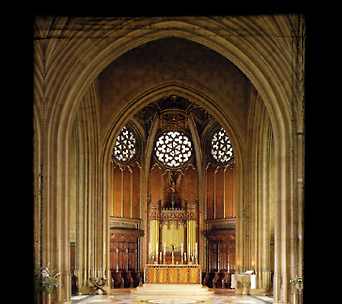
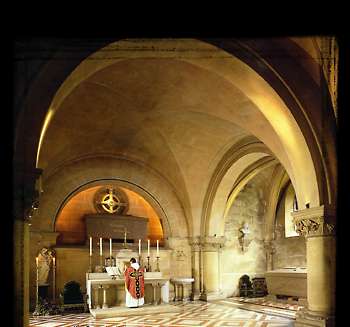
This is an amazing place, it was built for the body of Napoleon III who died in exile in England. It is French Gothic. I first went their on a foul November day and was amazed to see gargoyles gushing water. The Church is glorious, yet this is also a working monastery, it is now also the home of the Catholic Library.


It has had a number of different groups of monks living there, first of all Canons of Premontre, then a golden age of Solesme Congregation, now, I think they are Subiaco Congregation. Again in the last few years it looked as if they were going to die out, they had three or four monks. The Prior undertook an extra-ordinary policy of renewal, first of all getting rid of the pastoral responsibilities of the parish ansd concentrating on the monastic life. It attracted men like liturgist, Alcuin Reid, who has since left. Also, there was a great project to restore the monastic buildings, primarily the Church and Imperial Crypt back to what the 19th century architect had intended, now Farnborough seems to be thriving. One of the reasons seems to be that they have taken on traditional approach to liturgy and monastic life.

The Lord’s descent into the underworld

At Matins/the Office of Readings on Holy Saturday the Church gives us this 'ancient homily', I find it incredibly moving, it is abou...