Charles and a few other people in the parish said they had never been to Tridentine Mass, though on holiday in Greece they had been to plenty of Byzantine Rite Liturgies. This is Mass from St Nicholas of Chardonet in Paris, it is run by the schismatic St Pius X group, so when you watch it pray for an end to the schism.
There is something quite wholesome, even human about this liturgy, the Church is full, there are lots of little servers who don't know quite what to do, the boy with the holywater needs to be held by the priest to prevent him running ahead, there are young parents with noisey children, the music is a bit irritating in parts; it is a nice Parish Mass.
I am afraid it goes on for a bit over an hour.
I found it on Fr Michael Brown's blog.
Showing posts with label liturgy. Show all posts
Showing posts with label liturgy. Show all posts
Monday, December 18, 2006


Saturday, December 16, 2006
O Sapientia, quae ex ore Altissimi prodisti,
You could also have a look at the Archbishop of Cnaterbury's St Anselmo Lecture, which is well worth a read.
Tuesday, December 12, 2006
Ecclessia Dei interview

ANSA) – CITTÀ DEL VATICANO, 12 dic
The publication of the Motu Proprio on the part of the Pope which will liberalise the celebration of the Mass in Latin according to the missal of Saint Pius V is close` Cardinal Jorge Arturo Medina Estevez, member of the Commission Ecclesia Dei which this morning met to discuss the liberalisation of the Mass in Latin confirmed this. ” We have studied the document calmly” the cardinal affirmed. ” We have discussed together for more than four hours and have made some corrections to the text of the Motu Proprio” The next move belongs to Cardinal Dario Castrillon Hoyos ( president of the commission) who will present the text to Benedict XVI. Perhaps, added Medina, there will be another meeting of the Ecclesia Dei commission. Another member of the body, the Cardinal of Lyon, Jean Pierre Ricard did not want to make any comment, emphasising that he is “bound by the pontifical secret”
Comment by FranzJosf
Vatican, Dec. 12, 2006 (CWNews.com) - At a December 12 meeting, the Ecclesia Dei commission discussed a papal document that will broaden access to the traditional Latin Mass, Cardinal Jorge Medina Estevez confirmed after the Tuesday-morning session. The Chilean cardinal said that he expects Pope Benedict XVI (bio - news) to release the document in the near future.
Cardinal Medina Estevez, the former prefect of the Congregation for Divine Worship, is a member of the Ecclesia Dei Commission, which was set up in 1988 to supervise Vatican relations with traditionalist Catholics. He confirmed that the group’s December 12 meeting was dedicated entirely to a discussion of a papal initiative that will allow more liberal use of the Tridentine rite.
The cardinal told the Roman news agency I Media that the results of today’s discussions would be presented to the Holy Father by Cardinal Dario Castrillon Hoyos (bio - news), the chairman of the Ecclesia Dei commission. He suggested that the Pope might then schedule publication of the document. Cardinal Medina Estevez indicated that he did not anticipate further discussion of the matter by the Ecclesia Dei commission.
Vatican insiders expect that the papal document, widely expected to take the form of a motu proprio, will give priests permission to use the Tridentine rite-- the liturgical form used throughout the Roman Catholic Church prior to Vatican II-- without requiring the explicit permission of the local bishop.
Thursday, December 07, 2006
Thoughts on the "Old" Mass
The Pope (then Card. Ratzinger) celebrating Holy Week in the "Old" Rite.
I can't really imagine a lot of priests wanting to say the "Old" Mass but I do think that priests like me, and the younger generation of priests, who have never celebrated it need the presence of this form of the rite to know from where our tradition comes.
The Pope has said repeatedly that "New" Mass sprang "ex nihil" from a post-Vatican II commission of "experts", see his book “The Spirit of the Liturgy”. Ecumenically, the criticism of the Eastern Churches is that we have dispensed with our tradition. I remember a conversation with an Orthodox priest who when I suggested he should become a Catholic, after over half a bottle of Ouzo had disappeared, asked, “How could any Orthodox come into communion with the Bishop of Rome when he assumes the power to remove 2000 years of tradition from the Church with a stroke of a pen”. Pope Benedict when taking possession of the Cathedral of the Lateran said that the Pope was not there put to forward his own views but to re-present the Church’s Tradition.
What the Pope tried to do (as Cardinal Ratzinger) both in his writings and speeches, as well as his actions was to give the “New” Mass roots. It is after all the “Old” Mass that is the root of the “New”, not a something which springs from the Protestant Tradition, thus even in the introduction to the Missal it is Gregorian Chant and Polyphony that are the norm for music in the liturgy not “Hymns Ancient and Modern” or the latest thing published by Mayhew or McCrimmond, it is certainly not the charismatic “Worship Service”.
The “Old” Mass teaches us that the liturgy is an act of worship and not a didactic exercise; the priest is the one who offers prayer and intercedes on behalf of the people, rather than a mere “worship leader”. I do believe that the “Old” Mass is necessary to remind us of the Churches continuity from the time of Christ through the subsequent two millennia to the present day. In the eighties I remember preaching about the Real Presence, frequent Confession and the importance of Marian devotion and being told by a sister, “that is just so pre-Vatican II”, she is now married and the New Movements use these things as the basis of their life and growth. During that time it was as if the Church had reset the clock to year zero and in the seminaries a theology of rupture and discontinuity was so prevalent. I used to keep my Ratzinger books in brown paper covers!
Monday, November 13, 2006
A Cold and Concelebration

Apart from offering the Holy Sacrifice of the Mass, I spent most of the day in bed with a streaming nose and streaming eyes; no sympathy please, it is just a cold, and it will pass. I have a dreadful temptation though, which is to use it as an excuse not to concelebrate the annual deanery Mass for deceased clergy. The truth is I hate concelebrating. I wouldn’t mind attending in choir (wearing cassock and cotta). I don’t quite understand the theology of concelebrating.
At the seminary we were told it was a return to the ancient practice of the Church, preserved in the East. Yet having read Eastern theologians on the subject they would understand what they do in terms of assisting at Mass, dressed in liturgical vestments yes, but not “saying Mass” in our western sense, indeed surplus priests in the east would hardly open their mouths behind the iconostasis, let alone making any gesture, to indicate they were “co” or “con” –celebrating. I have never heard of the vast concelebrations in the East that we have in the West.
I knew an old priest who was a little eccentric and used pride himself on concelebrating things like the Chrism Mass, he would say the words of consecration sotto voce but always a little ahead of the bishop and other priests, and afterwards he would tell me, he had, “got in before everyone else”, and therefore all their Masses were invalid, “because they were merely saying words over elements that were already consecrated.”
I understand that having dozens of clergy celebrating especially with the bishop is a sign of the unity of the presbyterate and in that sense has an important purpose and people seem to like it.
The problem is most liberal clergy see it as sign of unnecessary division in the Church and traditionalists like me cannot see its purpose.
Now my eyes are streaming again and I am sweating, so maybe tomorrow I will have no choice but to stay home.
Tuesday, October 24, 2006
Bad music is destroying the Church

James MacMillan has this interesting article, reprinted in the Catholic Herald it is well worth reading just for its polemical style. I agree with MacMillan's arguement, as one of the few leading Catholic composers we should listen to him carefully.
There is a new momentum building in the Church which could be directed to bringing about this new, creative “reform of the reform”. Part of that momentum comes from a widespread disgust at what was described recently as “aisle-dancing and numbskull jogging for Jesus choruses at Mass”. The days of embarrassing, maudlin and sentimental dirges such as “Bind us together Lord” and “Make me a channel of your peace” may indeed be numbered. Are we seeing the end days for overhead projectors, screaming microphones and fluorescent lighting and their concomitant music, complete with incompetently strummed guitars and cringe-making, smiley, cheesy folk groups? The American writer Thomas Day describes this kind of liturgy as “a diet of romantic marshmallows indigestibly combined with stuff that grabs you by the scruff of the neck and shakes you into submission with its social message”. “What was the rationale of such music?” asked John Ainslie, one-time secretary of the Society of St Gregory, writing in the 1970s. “Many well-intentioned nuns, teachers and later priests thought that such ‘folk music’ would appeal to teenagers and young people generally and so encourage them to participate in the Liturgy instead of walk out from it. “The term ‘folk music’ is, of course, misleading. There is nothing, for example, to link it with the English folk-song tradition... The name was no doubt coined partly because some of the early repertoire was imported from the United States, where it might have been called folk music with some justification, partly because it was felt that the style had something in common with the musical tastes of today’s younger generation and their sub-culture. But it has never been persuasively shown that whatever young people may find attractive to listen to in a disco, they will find attractive to sing in church. “Further, the style is unsuitable for singing by large congregations... more so if the only accompaniment provided is a guitar rather than the organ, since guitars, even amplified, have insufficient ‘bite’ to keep a whole congregation singing together and to give them the support they have come to expect from the organ.” Liturgy as social engineering has probably repulsed more people from the modern Catholic Church than any of the usual list of “social crimes” trotted out by the Church’s critics. Like most ideas shaped by 1960s Marxist sociology, it has proved an utter failure. Its greatest tragedy is the wilful, de-poeticisation of Catholic worship. Our liturgy was hi-jacked by opportunists who used the vacuum created by the Council to push home a radical agenda of de-sacralisation and, ultimately, secularisation. The Church has simply aped the secular West’s obsession with “accessibility”, “inclusiveness”, “democracy” and “anti-elitism”. The effect of this on liturgy has been a triumph of bad taste and banality and an apparent vacating of the sacred spaces of any palpable sense of the presence of God. The jury is still out on any “social gains” achieved by the Church as a result. It may be timely and sobering to reflect on what we have lost. In the early 1970s Victor Turner, the cultural anthropologist, wrote of the old Roman rite: “One advantage of the traditional Latin ritual was that it could be performed by the most diverse groups and individuals, surmounting the divisions of age, sex, ethnicity, culture, economic status, or political affiliation. “The liturgy stands out as a magnificent objective creation if the will to assist both lovingly and well was there. Now one fears that the tendentious manipulation of particular interest-groups is liquidating the ritual bonds which held the entire heterogeneous mystical body together in worship.”In the light of this, the reformed liturgy can be seen as yet another glaring failure by the Leftists in the Church to deliver, even according to their own agenda. It was not meant to be like this. Reading the Sacrosanctum Concilium, the Council’s document on the liturgy, one realises just how much the spirit of true reform has been betrayed by the wilful misdirection of liturgical activists in recent times: “Servers, readers, commentators, and members of the choir also exercise a genuine liturgical function. They ought, therefore, to discharge their offices with the sincere piety and decorum demanded by so exalted a ministry and rightly expected of them by God’s people.” (Sacrosanctum Concilium [SC] Chapter 3, Section 29)“The treasury of sacred music is to be preserved and cultivated with great care. Choirs must be assiduously developed.” (SC, Chapter 6, Section 14)“The faithful are also to be taught that they should try to raise their mind to God through interior participation as they listen to the singing of ministers or choir.” (Musicam Sacram, Part 2, Section 14)
Monday, October 23, 2006
Rejecting teaching precludes receiving Communion, US bishops' draft says
 Who can be admitted to Holy Communion is one of the issues that the US bishops are asking this autumn, Nancy Frazier O'Brien summarises a paper up for discussion. I understand that it is something our own Bishops are being urged to discuss again.
A Catholic who "knowingly and obstinately" rejects "the defined doctrines of the church" or its "definitive teaching on moral issues" should refrain from receiving Communion, according to a document that will come before the U.S. bishops at their Nov. 13-16 fall general meeting in Baltimore.
The document, "'Happy Are Those Who Are Called to His Supper': On Preparing to Receive Christ Worthily in the Eucharist," requires the approval of two-thirds of the members of the U.S. Conference of Catholic Bishops for passage.
In an introduction, Bishop Arthur J. Serratelli of Paterson, N.J., chairman of the USCCB Committee on Doctrine, said the draft document was the result of a proposal to the bishops in November 2004 by Archbishop John J. Myers of Newark, N.J., for a statement on how Catholics should prepare to receive the Eucharist.
"He envisaged this document as applying to Catholic faithful, not just to politicians or those in public life," Bishop Serratelli said. Archbishop Myers' request came after a presidential campaign in which some bishops had criticized the Democratic candidate, Sen. John Kerry of Massachusetts, and said he and other Catholic politicians who supported abortion should be refused Communion under canon law.
But a footnote to the draft says that it is not intended "to provide specific guidelines" to the provision in canon law that says that Catholics "obstinately persevering in manifest grave sin" should not be allowed to receive Communion."
In order to receive holy Communion we must be in communion with God and with the church," the document says. "If we are no longer in a state of grace because of mortal sin, we are seriously obliged to refrain from receiving holy Communion. "Among examples of such sin, the document cites "committing deliberate hatred of others, sexual abuse of a minor or vulnerable adult, or physical or verbal abuse toward one's family members or fellow workers, causing grave physical or psychological harm; murder, abortion or euthanasia.
"Other "serious violations of the law of love of God and of neighbor" listed in the draft include swearing a false oath, missing Mass on Sundays or holy days without a serious reason, "acting in serious disobedience against proper authority," sexual activity "outside the bonds of a valid marriage," stealing, slander or involvement with pornography.The document criticized those who "give selective assent to the teachings of the church. "But Catholics who have "honest doubt and confusion" about some church teachings "are welcome to partake of holy Communion, as long as they are prayerfully and honestly striving to understand the truth of what the church professes and are taking appropriate steps to resolve their confusion and doubt," the draft says."If someone who is Catholic were knowingly and obstinately to reject the defined doctrines of the church, or knowingly and obstinately to repudiate her definitive teaching on moral issues, however, he or she would seriously diminish his or her communion with the church," it adds. "Reception of holy Communion in such a situation would not accord with the nature of the eucharistic celebration, so he or she should refrain."If a person who "is publicly known to have committed serious sin or to have rejected definitive church teaching and is not yet reconciled with the church" receives Communion, it could be "a cause of scandal for others," giving "further reason" for the person to refrain, the bishops said.
The document says Catholics should get ready to receive Communion through both "remote preparation" -- prayer, Scripture reading, frequent confession and other steps -- and "proximate preparation."The bishops said elements of proximate preparation include maintaining "reverent silence" before Mass begins; refraining from food and drink for an hour before receiving Communion; dressing "in a modest and tasteful manner" at Mass; listening attentively to the Scripture readings and homily; and actively participating in the Mass "with our whole hearts and minds and bodies."The bishops also urged Catholics to make "a reverent bow of the head" before receiving Communion.
"If we perform these simple actions, we will enter more profoundly into the eucharistic celebration, receive the Eucharist more worthily, and thus obtain more fully the grace of communion with the risen Lord Jesus and with one another," the document says.
The draft also includes two appendices explaining church teaching on when non-Catholics can receive Communion in a Catholic church and when Catholics are permitted to take Communion at a non-Catholic service.
"When participating as guests in worship services in other Christian communities, Catholics are encouraged to join the community in the shared responses and in the singing of hymns," the document says. "It would be inappropriate, however, for Catholics to take communion in other Christian communities."The document also reminds Catholics who join in non-Catholic services on a Sunday that "the obligation to participate at a Catholic Mass still remains."ration, receive the Eucharist more worthily, and thus obtain more fully the grace of communion with the risen Lord Jesus and with one another," the document says.
Tuesday, October 17, 2006
St Mark's - A Liturgy Without Hymns

Adoremus Bulletin, which liturgy nerds love, has an interest article by Joseph Swain, St Mark's -- A Liturgy Without Hymns. It follows on from some of last weeks posts
Music?
&
A Catholic Head of Music on Catholic Music
In Venice they have cantors and polyphonic choir, but Sacre Coeur, Paris used to celebrate very elegant litugies with merely a couple of cantors singing French psalmody at the entrance, between the readings, at the offertory and communion, the congregation joined in with the Ordinary (the Gloria, Kyrie, Sanctus & Agnus Dei) and the Alleluia. Some of the most beautiful liturgies here have been funerals with just the Ordinary, Alleluia and a Marian Anthem, often without organ.
I wish I had the courage to ban all hymns, except the sequences which are specifically named in the lectionary.
Thursday, October 12, 2006
Tridentine Mass 4.00pm this Sunday
 Thinking more about the Tridentine Rite: whenever I have encountered it on the continent, rather than being something for the elderly, seems to be filled with young people. We struggle with filling our seminaries, whereas wherever the old rite is celebrated I get the impresssion the problem is building seminaries, or at least ensuring that there are enough places for students. The priests who celebrate this rite, on the continent, and apparently in the US, are not the elderly, but men in their twenties and thirties and even in this country they seem to be the zealous, devout and learned. Far from dying out there seems to be a serious growth in the Tridentine Rite. One could talk about it as a youth movement. Indeed there seems to be a fecundity about it that is lacking in the sterility of "mainstream" liberal European Catholicism.
Cardinals like Ratzinger, Castrillon de Hoyos, Medina Estevez and many others have been happy celebrating the "Old" Rite, even before the setting up the Ecclesia Dei Commission to reconcile Archbishop Lefebvre's followers. So many people have been seriously concerned about how the Mass is celebrated, there were several documents by the late Pope on the celebration of the Mass most of which were ignored by the bishops to a greater or lesser degree. Pope Benedict has always been involved in the Reform of the Reform, in his book "The Spirit of the Liturgy", which is really a manifesto for Reform, he wrote about the importance of priest and people facing east, the ancient direction for Christian prayer (not forbidden by the council), recovering the sense of the sacred, the need for silence, the need for a sense of continuation.
The bishop's have not responded to other forms of encouragement to reform the liturgy. Any liberation of the "Tridentine Rite" would be intended to encourage a groundswell movement to reform the present rite of Mass, with the emphais being placed on the choice of priests, rather than the permission of bishops. This would seem to be a winning course of action, as liberalism by its very nature shows itself as being sterile, as far as practice, catechesis, vocations and even the growth in family are concerned.
Wednesday, October 11, 2006
Tridentine Indult
Cardinal Ratzinger ordaining priests according to the Tridentine Rite
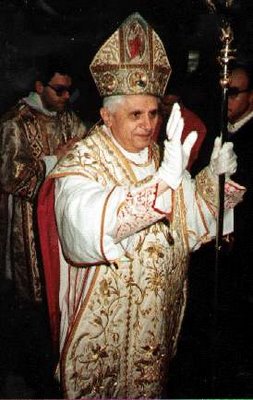 I have to confess I love clerical gossip, not the wicked destructive type than kills reputations and drags everyone into hell. Well what seems to be the subject of rumour and gossip at the moment among clerical circles is the extension of the "indult" to say the Tridentine Mass. Various high ranking ecclesiastics are saying the Pope is going to sign something in November, they might be the same people who had said it was going to be Holy Week, this year, or summer but this has being going ever since Pope Benedict was elected.
 I have to confess I love clerical gossip, not the wicked destructive type than kills reputations and drags everyone into hell. Well what seems to be the subject of rumour and gossip at the moment among clerical circles is the extension of the "indult" to say the Tridentine Mass. Various high ranking ecclesiastics are saying the Pope is going to sign something in November, they might be the same people who had said it was going to be Holy Week, this year, or summer but this has being going ever since Pope Benedict was elected.
I am sure something is going to happen, sometime. What is more certain to happen is that Holy Father going to reply to statements of the Bishops who met for the Synod on the Eucharist last October, and maybe, just maybe, he might choose to extend the "indult" then.
I love Eastern Rites of the Liturgy and love Solemn High Tridentine Mass, the music, the colour, the antiquity of it is glorious; Low Mass however is another matter, it does enshrine the sacredness of silence but to be honest from the congregations point of view it is a bit dull.
I am a supporter of the Tridentine Mass, really because without it the present Mass, is as the Pope say, rootless, "ex nihil".
The Tridentine Mass, parts of which vanish into antiquity, was the liturgy that formed Europe, responsible for so much of its architecture, its painting, its music. I personally think its abandonment contributed greatly to the secularisation of Europe in the 20th century. Whether its limited restoration, for those who want it, will change much, time will tell.
Fr Benjamin Durham FSSP celebrates in the Tridentine Rite here on 3rd Sunday of each month, that this Sunday.
Monday, October 09, 2006
Music?

I had a long discussion with one of my parishioners about music I always seem to have discussions about music: Lord send us musicians, is my constant prayer. Now I always have to add whole list of footnotes to this,
1. who will deepen our prayerfullness at the liturgy
2. who understand what the liturgy and prayer are about
3. who sing in tune and follow the right rhythm
4. who if they are going to want a fee, because they are that good, will somehow not charge us because we are a poor parish
5. who will be much more concerned about singing the texts of the liturgy rather hymns
6. who will not alienate the people
Well what God knows I want, is a group of people that will sing Missa di Angelis, Orbis Factor, the Lent/Advent Mass, an occasional anthem, maybe a little bit of polyphony, a cantor or two who could sing a psalm, the verse of the Alleluia for our morning Mass and them maybe something that will call younger people into actual participation in the evening Mass. I don't really mind if itis Latin or English, except the Endlish translations areso dreadful, and most modern setting are pretty ghastly.
Well what God knows I want, is a group of people that will sing Missa di Angelis, Orbis Factor, the Lent/Advent Mass, an occasional anthem, maybe a little bit of polyphony, a cantor or two who could sing a psalm, the verse of the Alleluia for our morning Mass and them maybe something that will call younger people into actual participation in the evening Mass. I don't really mind if itis Latin or English, except the Endlish translations areso dreadful, and most modern setting are pretty ghastly.
It isn't much to ask God, is it?
We are multi-cultural community, English isn't really a common language, it would be good if music was but it isn't. Even the music used at our local secondary school, most of the adults in our congregation most probably wouldn't want to sing.
The New Liturgical Movement, Chiesa, Open Book (see the sidebar) and also James MacMillan the Scottish composer all seem to be writing about music at the moment .
The New Liturgical Movement, Chiesa, Open Book (see the sidebar) and also James MacMillan the Scottish composer all seem to be writing about music at the moment .
Saturday, September 30, 2006
Thursday, September 28, 2006
News from ICEL: Good on ya' Bruce
 The back story is that the English translations of the Mass are so poor, so full of theological inexactitudes, that Pope John Paul II ordered a new translation of the entire Missal. Msgr Harbert, who incidently used to be a priest of our diocese and worked in Brighton as chaplain to the University here, is in charge of producing these translations. Many of us have been waiting for these translations with great eagerness.
Sean Tribe has this:
"Monsignor Bruce Harbert, executive secretary for ICEL and a member of the Society, announced his personal hope that the new-and-improved ICEL translation of the Latin Missal will first be used by the Holy Father at World Youth Day 2008 (Sydney, Australia). That, he said, is not beyond the realm of possibility, since ICEL has finished its work on the Ordinary of the Mass and is expected to complete the translation of the propers by this time next year (leaving sufficient time for Rome’s final approval of the work)."
Wednesday, September 27, 2006
Rite of degradation of a Bishop (or Archbishop)

Milingo's act of schism which caused his automatic excommunicaton has sent a buzz round some websites about the "Rite of Degradation of a Bishop", it was ordered to be printed for the first time in 1862 on the instruction of another Benedict, Benedict XIV.
Though one might suggest names, even those who qualify seem loathe to come forward to be publicly degraded, so I do not know when it was last used.
THE RITE OF DEGRADATION of a BISHOPIf the degradandus be an archbishop, the degrading prelate removes his pallium, saying:
We deprive thee of the rights and privileges of the episcopal dignity, symbolized in this pallium, since thou hast abused them.
Then, even if the degradandus be a mere bishop, the degrading prelate removes his mitre, saying:
We strip thy head of this miter, emblem of the episcopal dignity, since thou hast befouled it by thy ill government.
Then one of the ministers brings the Book of the Gospel to the degradandus, which the degrading prelate takes from his hands, saying;
Give us back the Gospel! Since thou hast spurned the grace of God and made thyself unworthy of the office of preaching, we rightly deprive you of this office.
Then the degrading prelate removes the ring from the finger of the degradandus, saying:
Rightly do we pull off thy ring, the sign of fidelity, since thou hast made bold to rape God's own bride, the Church.
At this time one of the ministers brings the degradandus a crosier, which the degrading prelate takes from his hands, saying;
Thy shepherd's staff we take from thee, that thou shalt be powerless henceforward to exercise that office of correction, which thou hast brought to disarray.
Then the ministers take off the gloves of the degradandus, and the degrading prelate lightly scrapes thumbs and hands with a knife blade or a shard of glass, saying:
We hereby deprive thee, to the extent of our powers, of the grace of spiritual blessing and of sacramental anointing, that thou shouldst forfeit the office of sanctifying and of blessing, and their effects.
With the same knife blade or shard the degrading prelate lightly scrapes the head of the degradandus, saying:
We utterly erase and eradicate the consecration, blessing and anointing bestowed upon thee, and we put thee out of the episcopal order, whence thou returnest unclothed.
The ministers remove the shoes from the degradandus Thus ends the ceremony.
He was then hand over to the civil authorities for secular punishment with the plea that blood should not be spilt nor should he be treated harshly.
Wednesday, September 20, 2006
Archbisop Fulton Sheen's commentary on Mass On Easter Day 1942
I have been exploring You Tube and found this, the chant is splendid, the Ordinary is of its time, the commentary sparse but eloquent, it lasts for almost an hour, but has been edited down.
It is my "contribution" to the CIEL conference in Oxford which I would like to have attended. Fr Tim Finigan has photographs on Hermeneutic of Continuity.
It is my "contribution" to the CIEL conference in Oxford which I would like to have attended. Fr Tim Finigan has photographs on Hermeneutic of Continuity.
Saturday, September 16, 2006
Communion and Lovers

I had lunch with Lisa and Ted yesterday, they were married last year, they are still very much in love, in that delightful way, normally reserved to the young, Lisa is in her 40s, Ted is in his 60s, a retired CIA agent, troubled by America's middle east policy, he is quite fascinating on the subject. We went to a rather good Notting Hill Italian restuarant. What struck me was that lovers always seem to want to feed one another, to put food into one anothers mouths, Lisa kept wanting to put food in Ted's mouth.
I think that when we speak of Holy Communion, we forget that the priest stands in the place of Christ, the bridegroom; the communicant in the place of the Church, the bride. I was struck that communion in the hand looses something about the intimacy of this sacred act: communion is about Lovers.
See Fr Tim Finigan for some early evidence for communion on the tongue.
Subscribe to:
Posts (Atom)
The Lord’s descent into the underworld
At Matins/the Office of Readings on Holy Saturday the Church gives us this 'ancient homily', I find it incredibly moving, it is abou...
-
 Have a look at this post , and this one Yesterday I received an email saying: I need to tell you that your comments have caused widesprea...
-
 A French newspaper has reported Pope Francis, once Benedict dies, will abrogate Summorum Pontificum and handover Old Rite's celebrat...
-
After recent happenings I have been thinking I ought to stop blogging. I do not think I have done anything wrong but if journalists, like ...


