Showing posts with label art. Show all posts

Sunday, October 15, 2006

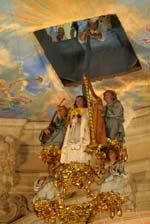
Misteri Play d’Elx


The d'Elx Mysteri Play, about the Blessed Virgin's Assumption was performed on Radio 3, on Saturday "they called it Elche", listen.
When the Council of Trent forbade such spectacles in Church, the local citizenry petitioned the Pope for an exemption, and the play has been performed in the Cathedral ever since.
Everything is sung, so it is really a very early opera, all the players are men or boys and sing monody and ployphony in an extra-ordinary open throated way, some of the parts of this play go back to the 13th Century. Look at this site which is translated by machine unfortunately, but is fascinating.

Wednesday, October 04, 2006

Another Spaniard in St Peter's

Alessando Romano, the Roman sculptor, working on a new sculpture of Saint Genoveffa Torres Morales, who died in 1956, which the Holy Father blessed this morning. The last new sculpture in St Peter's was of another Spaniard, Saint Jose Maria Escriva, the founder of Opus Dei.
She founded a new religious congregation caring for those who were neglected by everyone else. She herself had lived in an orphange from the age of thirteen when she was cripple by a tumour on her led, she is shown with a crutch

Saturday, September 30, 2006

I found this on YouTube.
Valle Adurni has, ":-" their Regensburg correspondent but here is the choir that Prelat Ratzinger, the Pope's older brother, used to run, nice pictures too. They are singing a Christus Vincit.

Wednesday, September 27, 2006

Berlin opera cancels Mozart production


Berin opera house said it has canceled a controversial production from its fall season, citing authorities' fears it posed undue security risks because it featured the severed heads of Buddha, Jesus and Muhammad.
In a statement released late Monday, the Deutsche Opera said it had decided "With great regret" To cancel a planned production of Mozart's "Idomeneo" From its fall season, after Berlin security officials warned of an "Incalculable risk" Due to scenes dealing with Islam, as well as other religions.
After its premiere in 2003, the production by Hans Neuenfels drew widespread criticism over the scene in which King Idomeneo presents the severed heads, not only of Poseidon, but of Jesus, Buddha and Muhammad.

"We know the consequences of the conflict over the (Muhammad) caricatures," The opera house said in a statement. "We believe that needs to be taken very seriously and hope for your support."
Germany's top security official, Interior Minister Wolfgang Schaeuble, who is visiting Washington, condemned the decision, which came ahead of a planned Wednesday
conference on Islam.
"That is crazy," Said Schaeuble told reporters. "This is unacceptable."


In Berlin they could of course not insult Judaism by featuring Moses. It is not Jesus or Buddha that is a problem, it is the fear of Islam. I say perform and be damned. It is now hardly original to be deliberately offensive to religions, what is being said, religion is something to be overcome? It reminds me of the performances put on during the French Revolution, Reason enthroned on the High Altar of Notre Dame du Paris, donkeys drinking out of chalices. The truth is of course, as history has shown, that what was really being portrayed was a culture that had lost its respect for any human values and moved from the Reign of Terror to the Napoleonic wars of European dominaton.

Sunday, September 24, 2006

Holbein in England at Tate Britain

Exhibition: 28 September 2006 – 7 January 2007

Hans Holbein (1497/8–1543) was the first great British artist, and is regarded as one of the greatest artists of all time. He moved to England from Basel in 1526–8 and then again in 1532–43, an extremely turbulent time in English history when all around were losing their heads. His arrival effectively brought the Renaissance in painting from continental Europe to Britain. This major exhibition, which includes numerous remarkable loans from around the world, concentrates on the work Holbein produced in England under the patronage of the Tudor court and for King Henry VIII. Through an outstanding collection of paintings brought together from around the world, this exhibition documents the thrill of the court and life in Tudor England, reflecting the unsettled history and politics of the time.

Holbein in England concentrates on the artist’s two periods working in London: 1526 – 1528 and 1532 – 1543. For the first three years Holbein was working under the patronage of Sir Thomas More, a friend and admirer of Holbein’s previous patron in Basel, the important Humanist scholar Erasmus. He left London in 1528 for Basel but returned in 1532 and stayed until his death in 1543. During this latter period Holbein is best known for his portraits of King Henry VIII, the artist’s patron from about 1535 - 1543.


Structured both chronologically and thematically, a section of the exhibition will be dedicated to the images of the king and his family. Other sections will look at members of the royal court and examine the revival of intellectual learning of secular Humanism, the turmoil of religion and the Reformation.


Throughout, the exhibition will investigate the development of Holbein’s portraiture and the relationship of its differing forms to the various groups of patrons for whom he worked. It examines his work for the Protestant Reformation in relation to traditional religious beliefs and explores how he used his own portrait drawings and paintings, as well as other sources including sculpture, to develop a finely-poised balance between individualised character and ideal presentation. Finally the exhibition will highlight the artist’s contribution to the revolution in English decorative design, examining the ways in which his sophisticated understanding of the new classical decorative vocabulary was applied to designs for goldsmiths as well as to large-scale paintings.

Friday, September 22, 2006

Something nice


The pictures start of with the legend of St Joseph, the birth the Virgin etc.

Monday, September 18, 2006

PD James' distopia: The Children of Men


It is the year 2021. The last birth recorded on earth occurred in 1995 (Year Omega). In England, Xan Lyppiatt is Warden; he promises security, comfort, and pleasure to his people. Xan's cousin, Theo Faron, Ph.D., retired professor of history at Merton College, Oxford, becomes involved with 5 people who oppose Xan's worst policies: the Quietus ("voluntary" mass suicides of the elderly), the sending of all criminals to the Man Penal Colony where there is no one to control cruelty, the rules forbidding Brits from traveling abroad and allowing only Sojourners (slave/workers) to emigrate, the compulsory testing of sperm and routine examinations of healthy women, and state-run porn shops. Theo and the 5, one of whom is pregnant, flee to avoid capture by Xan's men.
Commentary:
Dolls replace babies as objects of women's affections; animal births are cherished events. Safety and comfort are prime government promises. People with any kind of disability (from diabetes to withered limbs) are second-class citizens, not included in compulsory fertility testing.
Two of these disenfranchised people (part of the group of 6 who oppose Xan's policies) come together to produce the first "new" baby. Even with this new birth, however, the future isn't rosy, for Theo kills Xan (who wants, to increase his power, to take credit for the new baby), dons Xan's Coronation Ring, and, the author hints, may end up having the same desire for total power that infected Xan. As an imaginative piece of popular fiction by one of England's best contemporary mystery writers, this novel can stimulate lively discussion of power relationships inside and outside of medicine.
The film of this book is to be released later this week

Saturday, September 16, 2006

The Temple Gallery

I visited my favourite London shop today, The Temple Gallery, when I go there I always have to wrestle with myself to not buy an icon, have a look at their catalogue, "a cheap one" normally costs a third of annual income. Some 19th century one's cost a few hundred pounds, others, from the 15th/16th century, several ten's of thousands.


I met Richard Temple, the owner who writes on icons and iconography, very interesting. His catalogues are really quite splendid and lavishly illustrated. The gallery is a ten minute walk from Holland Park tube station, it is tiny, but if you have an interest in icons well worth a visit.

click here fro on-line catalogue

Wednesday, August 16, 2006

Dormition in east and west

I thought this was a wonderful example how the art of the eastern and western Church seperated.
The Flemish painting is published on, http://www.danielmitsui.com/hieronymus/, always interesting.
Compare and contrast at your leisure. Posted by Picasa

The Lord’s descent into the underworld

At Matins/the Office of Readings on Holy Saturday the Church gives us this 'ancient homily', I find it incredibly moving, it is abou...