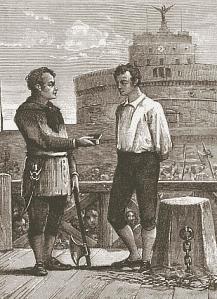
.... Under this fiendish Emperor every form of torture was imagined and having been imagined was visited upon the Church of God, sparing neither the Holy Apostles themselves or clergy, man or women, even little children, widow or orphan, all were subject to the rapacious will of this Pontifex Maximus ....
... The sycophants about him, who should have stayed his hand as true friends, encouraged not only his violence but his viciousness which spared none. How low his court fell, and with them the morals of the people of Rome. For once the ruler becomes vile and corrupt soon the whole edifice is weakened and crumbles and is plunged into hatred, yes, of the Church and Christian people but also of goodness itself, so that virtue is lost and vice extolled ...
From a sermon for St Peter and Paul by one of my predecessors, not quite sure who, in the 1920s/30
A Lutheran academic most probably only moves in rather restricted circles, possibly one should ask where have Protestants won? The question however provokes other questions.
Such as where do we find Catholicism? Is it in the documents of VII, or the theology of Cardinals Cupich or Marx, or in an ecumenical gathering, or is it the congregation at weekday Mass or the Rosary Procession through London last week or is it in the millions today that would term themselves 'former Catholics' or 'of Catholic descent', who have turned their back on the Church and its teaching?
Who 'owns' or controls the Church?
Is it the 'possession' of the Pope and a small group vociferous twittering bishops, media savvy academic theologians and other clergy and journalists, or is something else?
I am no Church historian but it strikes me that Luther was the first 'theologian' in the modern sense, we had men like Aquinas and Bonaventure but they were quite different, they tried to make sense of an an already existing faith and explain it. In a sense their teaching persisted for centuries until it was actually taken up the Church, an example is Aquinas' use of 'Transubstantiation', it was only the Council of Trent that took it up as a philosophical explanation of the Real Presence, even now we can ask do we have to believe in a divide between 'substance' and 'accidents' to be a good Catholic or can we take it as analogy that explains why we prostrate before Blessed Sacrament and hold it as our greatest treasure and our contact point with God himself?
One could ague there have never been any Catholic theologians ever, even Newman (and Ratzinger at his best) were historians of theology rather than theologians in their own right, they, like good preachers tried to explain to their contemporaries an already existing faith (held always, everywhere and by all). If one follows this understanding of what a theologian is then all Catholic 'theologians' added nothing new but merely tried to bring out the treasure of the past and place it in the context of the present.
This is not what Luther or his contemporaries did, they invented something new, something personal. As soon as Protestantism emerges it is divided in itself. Luther has a different approach than Zwingli or Bucer or Calvin indeed they had savage disputes, they killed one another.
Luther himself said that before the Reformation there was one Pope sitting on seven hills, now every dung heap in Germany has its own Pope sitting on it. The creation of new 'churches' centred around particular theologians meant that princes were obliged to intervene for the sake of peace and order, so that religion became not something that somehow belonged to the people and bound them together but something imposed and regulated from above, by the 'prince'. I think until recently for example in England, atheist, nor-Christian, even Catholic Peers and Commons, actually had to vote on Church of England doctrine, and a non-Anglican, often non-believing, Prime Minister, in the name of the Queen, appointed its Bishops. Thus after the Reformation governments controlled what people believed, it became something imposed or something 'handed down', as opposed to something 'handed on'.
The Council of Trent, as a reaction to Protestantism for more or less the first time imposed a set of detailed doctrines on the glorious muddle of medieval Catholicism. Previous Councils had predominantly merely told the faithful what to avoid. Even then it is only with VII that the Catholicism becomes imposed from above, mainly in the liturgy of course, 'the Pope' or 'the Council wills it', became a standard phrase in post-Concilliar Catholicism, trumping Tradition or the feelings of ordinary Catholics, especially in liturgical 'reformation' of Vatican II was imposed with such destructive violence whereas so much else of VII was quietly rejected. For the first time the will of the Pope was seen as greater than the historic will of the rest of the Church, it seems to be attitude reaching it zenith in the present Papacy.
Authentic Catholicism is about a movement of the Spirit in the hearts of the faithful, expressed in worship and devotion. The more it is formalised, and taken away from what was taught at grandmother's knee, when it becomes the subject of documents, or individuals, even of Popes and Bishops the more Protestant it becomes, and I would suggest, therefore, the more empty our churches become.
Just one reason why I can't join the Vicar of Christ in celebration of the heresiarch Luther:
... a shocking part of Luther’s legacy seems to have slipped though the cracks of the collective memory along the way: his vicious Anti-Semitism and its horrific consequences for the Jews and for Germany itself. At first, Luther was convinced that the Jews would accept the truth of Christianity and convert. Since they did not, he later followed in his treatise, On the Jews and Their Lies (1543), that “their synagogues or schools“ should be “set fire to … in honor of our Lord and of Christendom, so that God might see that we are Christian.“ He advised that the houses of Jews be “razed and destroyed,“ their “prayer books and Talmudic writings“ and “all cash and treasure of silver and gold“ be taken from them.
They should receive “no mercy or kindness,“ given “no legal protection,“ and “drafted into forced labor or expelled.“ He also claimed that Christians who “did not slay them were at fault.“ Luther thus laid part of the basic anti-Semitic groundwork for his Nazi descendants to carry out the Shoah. Indeed, Julius Streicher, editor of the anti-Semitic Nazi magazine “Der Stürmer,“ commented during the Nürnberg tribunal that Martin Luther could have been tried in his place.
All the more stunning that Germany should proclaim a special national holiday in the name of the anti-Semitic Martin Luther only 70 years after the Shoah. Although the general public may mostly be unaware of Luther’s views, the responsible clergy certainly is aware and has still chosen to declare a nationwide holiday.
It is no doubt laudable that the Synod of the Lutheran Church in Germany (EKD) distanced itself from Luther’s anti-Semitic statements in November 2011, and several other church representatives have done the same, yet how do they have no compunctions about declaring a major commemorative event to honor Luther, as if his sinister and hateful views and writings on the Jews are insignificant and trivial? Times of Israel
The thing about the love of power and evil is that it casts out the work of sanctifying grace leavinf us thugish, corrupt and prone to all kinds of evil
I had always thought that conscience was important to Catholics: Newman famously said he would drink to the Pope but to conscience first, Aquinas, that we must follow conscience, even if leads one out of the Church.
Pope Francis, or at least the Beroglians, appear to be saying that the divorced and remarried may receive Holy Communion if they do so in good conscience, the problem is what if the priest who is expected to give them Communion feels in good conscience that he may not do so.
I heard a rather garbled account of a young priest, not a 'Correcton' signer, placed in this situation, after a discussion with his bishop he was led by conscience not quite out of the Church but to another diocese. it could be that this priest was tactless or harsh in how he said what he said, I don't know.
I get the feeling that this seems to be a phenomena that is likely to grow in the Church. On social media and in clerical chat rooms those priests whose comscience tells them the Gospel and Church promotes the former 'pastoral' practice seem very uneasy about their ability to continue in their dioceses. It seems that in some places lay people and bishops can freely follow conscience but not priests.
The implication for priests is if you insist on following your conscience you must find a diocese where the bishop allows or tolerates such a priest with such a conscience.
In the past conscience led priests to the arena, or the gallows or concentration camp and a bishop and those involved in their formation were concerned about sharpening not blunting conscience. An 'e-friend' priest said recently, 'they want us out and gone from the Church', that is probably an over reaction but there are obviously diocese, as in Malta where the seminary gate is open, as is, presumably, the diocesan gate where other bishops have told critical Catholics to stay away from events, the implication for priests whose conscience is sensitive is frightening.
This is presumably where schism begins; 'old' believers are simply told to go away or are unwelcome. The problem is that 'old' believers are so often the young, not the men and women of the 1970s. for a diocese in Europe or the US to lose even one of its younger priests today is pretty catastrophic.
The Pope changes the Church's teaching on the death penalty, is running on Twitter and a few blogs at the moment. Well that is not true, Popes do not, cannot, change Church teaching on anything, not even when they speak Ex Cathedra, All Popes can do is clarify.
The two 'classical' acts of such clarification, the Immaculate Conception and Assumption in many ways were completely unnecessary at the time of their promulgation, except to promote Papal power. The Church had and always will believe the Theotakos was 'full of grace', and had been from her beginning, what the doctrine does is say that Mary's beginning (and therefore our beginning) happened not at birth or at her quickening, or ensoulment but at the moment of conception. The Assumption, with its deliberate ambiguities reconciles the western doctrine of the Assumption and the Eastern doctrine of the Dormition, it purifies the doctrine of possible unnecessary pious legends.
Better uses of infallible teaching are Paul VI's declaration that contraception, (especially/including modern forms of artificial contraception) are contrary to the constant Tradition of the Church. Similarly JPII's, and maybe more clearly Benedict XVI's, declaration that women never have been and therefore never can be ordained priest are the more usual forms of 'infallible teaching' but these statements depend not so much on supernatural inspiration but the Holy See's library and record keeping. I have always thought that amongst the many papal titles ought to be a reference to 'keeper of the archives' or 'first amongst historians'. These are Church teaching because they are historic facts handed on to us, not because a Pope signs a document.
The problem is that if some other historical sources produced contrary historical evidence then 'infallible' teaching becomes very fallible.
So, Pope Francis has declared the death penalty is contrary to the Church's teaching, well the office of executioner to the Holy See has been unfilled for some time now and the Old Testament laid down quite clear rules about about when the death penalty must be enforced, so one can hardly say that the death penalty is historically contrary to Christian doctrine, however one of the strands that has been developed in Catholic theology, really since the declaration of the Immaculate Conception, is that Life, all life, is sacred, that Life is the fundamental right of all human beings.
For the Pope to say that the death penalty is contrary to the constant teaching of the Church is historically untrue. Obviously he can say that the death penalty is contrary to the Church's teaching but that is his opinion and should be taken seriously as he is Supreme Pastor. The problem is that an incoherent Pope or confused Pope damages the whole concept of Papal teaching. What Francis teaches us is to be sceptical about such teaching.
My friend, the rather brilliant theologian Fr Serafino Lanzetta asked me the question: What does Fatima say about Amoris Laetitia? It is a good question, a bit like the Zen master's question, 'what is the sound of one hand clapping?' On one level both questions could be answered by the simple answer, 'Nothing', but then both questions are to be pondered, sipped slowly, with no rash conclusion, both questions are in fact are profound.
I was 'formed' in a relatively liberal theological climate of the 1970s, it was fundamentally apophatic, to an almost snobbish degree, in our age it has reappeared with a vengeance. Apophatic (negative) theology isn't a bad thing in itself, it is a frank admission that God is beyond us, his ways are not our ways, there is always something unknowable about, ultimately he is Mystery but always it needs to be balanced with Cataphatic (positive) theology which tell us God gives us reason and revelation, especially through Jesus Christ allow us the know and love him. God became incarnate, so that in our flesh we might see him.
In the 1970s there was such a push against anything that spoke of mystery, of the supernatural, of the other, of anything that said we might actually be able to 'touch' God, it is fundamentally Arian, the belief that God did not become Man, Jesus was not what the anti-Arian Nicene Creed says so strongly that Jesus is consubstantial with the Father (Et ex Patre natum ante ómnia sǽcula. Deum de Deo, lumen de lúmine, Deum verum de Deo vero, Génitum, non factum, consubstantiálem Patri: Qui propter nos hómines et propter nostram salútem Descéndit de cælis. Et incarnátus est de Spíritu Sancto Ex María Vírgine, et homo factus est. Per quem ómnia facta sunt.), Arius could say none of this because Jesus for him was not fully God, just a form of God.
The theology that dominated this period was that of men like Hans Küng, which was far removed from the Catholicism of ordinary Catholics, it was very deeply rooted in the protestant Tübingen school which pioneered the historical-critical analysis of biblical and early Christian writings, which in certain hands could reduce the 'historic' Jesus' - who is different to the Jesus of faith - words to a message that could be written on the back of a postage stamp. Miracles like the feeding of the 5000 could be reduced to an act of sharing, the Incarnation and Resurrection to a mere myth, the Eucharist to a sharing in bread and wine, 'a meal for people today rather than the sacrifice of yesterday offered to God', Mary of course, who in Catholic/Orthodox theology is the resolute defender of true belief in the doctrine of the Incarnation lost her place of the triumphant Immaculate and becomes a doubter like any other woman, her sinlessness becomes an embarrassment and myth, a kindly mum, of doubtful virginity rather than the pure Theotokos, As Lumen Gentium says what can be said of Mary can be said of the Church, and so the Church becomes an old fashioned human institution that is in need of constant updating rather than the sacred bride of Jesus Christ.
It was of course against this background that Vatican II and the ecumenical movement and relationships with non-Christians grew up, it was in this environment that modern liturgy came into being and was implemented and all the world's bishops were chosen, and this environment in which the priests of my generation grew up.
Fatima, which I must admit for years I had difficulty with - Walsingham is ancient it is pretty harmless, Lourdes at least is useful, it is about healing. Fatima on the other-hand is different it is about so many unpalatable issues: judgement, penance, heaven and hell, condemnation and divine wrath, it is hot knife cutting through butter. It is so unsophisticated, a reflection of child-like peasant belief. In a world, a Church that has grown uncomfortable with the supernatural, it is profoundly super-natural, illogical, unscientific; God intervenes, the sun dances this is such a contradiction of what has now become the 'theological norm'.
Amoris Laetitia is from one world whereas Fatima from another.
Today millions of Poles are going to the peripheries of their country to say the Holy Rosary, which is a wonderful way to celebrate the feast of the Holy Rosary, it is also a demonstration of the power of the Polish Church. Could our English bishops or the Germans across one of Poland's borders be able to motivate such numbers of people?
The Feast of Our Lady of the Rosary is of course 'political', it marks the destruction of Islamic forces at the Battle of Lepanto, in the same way the importance of the conversion of Languedoc through St Dominic and the Rosary was important, because of the need to have strong Christian Lords on the borders of Christendom to counter the insurgence of Islam on the Iberian peninsula.
One political strand which I find interesting are the ecclesiastical politics of this event in Poland. Though Polish bishops would deny this was an anti-immigrant demonstration, the borders with Russia and the tensions there since the rise of Russian aggression against Ukraine and its other neighbours are as much a concern as the immigrant crisis. In Poland national identity is linked to its Christian identity. The British media see this event as an indication of Poland's far rightness.
For Catholics there has to be the question, "What would Pope Francis say? " though he has backtracked on open borders, as has Mrs Merkel, it seems pretty likely he would strongly disagree with the Polish bishop's and their people's actions. Yet the Polish bishops seem often in strong disagreement with the Pope, over Amoris Laetitia and JPII's magisterium, as much as over the issue of borders.
Here, a small group of Poles and their families want to come to the Church today to join their Rosaries to that of their compatriots, one of them said it was important to him because, "The Pope was so opposed to closing borders to immigrants who do not share Polish culture". I suspect he might oppose the Pope on numerous other issues, including those mentioned in the Filial Correction.
So for him and presumably other Poles the Rosary today is in part in opposition to the Pope Francis.