
Here are some pictures of last nights procession in honour of the Immaculate.

... one Lord Jesus Christ,Pope Francis speaks of Pelagianism or neo-Pelagianism but Pelagianism is the fruit of Arianism. If Jesus is less than God then his example rather than his Divine power becomes more important, it is our response to him rather than his Grace that becomes stressed, our response to him becomes more important than he is. His teaching becomes a memory of the Church rather than the dynamic power that remains with the Church until the end of time. He becomes a historic event rather than present Presence.
the only begotten Son of God,
begotten of his Father before all worlds,
God of God, Light of Light,
very God of very God,
begotten, not made,
being of one substance with the Father;
by whom all things were made;
who for us men and for our salvation
came down from heaven ...
 If we see the liturgy it terms of giving us comfort, bringing us closer to the memory of Christ rather than the act in which we participate in the life of the Father through the Son in the unity of the Holy Spirit we are probably Arian.
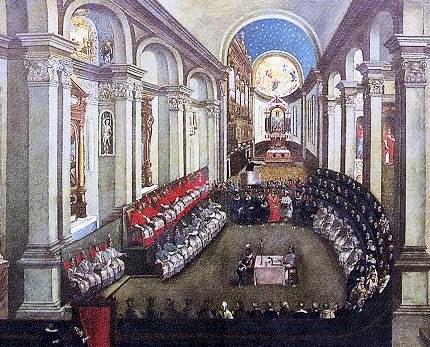
The achievements of the Counter-Reformation are breathtaking: It gave rise to great religious orders like the Discalced Carmelites, the Capuchins, and the Jesuits, who, in turn launched the great missions to South America, Africa, China and Japan. It gave birth to great saints like St. Teresa of Avila, St. John of the Cross, St. Ignatius of Loyola, St. Philip Neri, and St. Francis de Sales and inspired a new era of devotional fervor, as exemplified in books written by many of those saints, like The Spiritual Exercises and An Introduction to the Devout Life. And it created the form of Catholicism that withstood centuries of social strife and political turmoil, from the French Revolution to the emergence of communism...

Alison Davis was born with spina bifida. She later developed conditions including osteoporosis, arthritis and chronic obstructive pulmonary disease. Coping with these permanently disabling and painful conditions dominated but did not define her life. Indeed, they led her to champion the rights of the vulnerable, the disabled and the unborn, first as an atheist and then as a Catholic.
Her early adult life was marked by a determination to live as normal a life as possible, despite having to use a wheelchair. She studied sociology at university, where she stopped believing in God. Writing about this period of her life in a paper she delivered to a New Zealand Family Life International Conference in 2009 she was honest: “It was largely because I wanted to live a lifestyle I knew was incompatible with the Christian faith.” She married young, in 1975, but after ten years in which she “tried very hard to find happiness without God”, the marriage failed.
At university Alison had strongly supported a woman’s right to choose abortion but her attitude changed after she read of the case of a baby girl, Louise, born in 1979 with the same disabilities as hers, who had been deliberately starved and dehydrated to death by Dr Donald Garrow of the High Wycombe Hospital. The case, which received wide publicity at the time, shocked her to the core.
In 1981 the Guardian published a letter in which she criticised the killing of newborn disabled babies. The Society for the Protection of Unborn Children (SPUC) contacted her and argued that killing the newborn disabled was a consequence of killing the unborn. Alison was reluctant to give weight to SPUC’s arguments but within a couple of years she accepted them and became pro-life. From 1983 Alison worked full-time for SPUC’s newly developed Handicap Division (its name was later changed to No Less Human), for disabled people as well as their families and carers, and became a major commentator on anti-life policies which discriminated against disabled people.
John Smeaton, chief executive of SPUC, writes that “In spite of serious illness [Alison] continued to write, publish and broadcast on the eugenic nature of the Abortion Act and on healthcare and government policies, including major interviews on BBC’s Newsnight, the World Service’s Heart and Soul: Choosing Life series and leading letters in the national newspapers.”
In 1985 her marriage ended and in the following years a number of serious personal difficulties resulted in her making several suicide attempts. Yet paradoxically, she also started to search for religious belief. Having studied other world faiths, she turned to the Bible. “I began to think it could just be true,” she wrote. In 1986 she went to Scotland to stay with the prominent pro-life priest, Fr James Morrow of Humanae Vitae House in Braemar. He taught her to say the Rosary and she attended Mass in his chapel.
Yet the road to the Church was not easy and Alison still struggled to find meaning in life. Joining a pilgrimage to Lourdes she began to understand that she and the other sick people there were very much loved by God in their suffering. In 1987 she met Colin Harte who was working for SPUC. From 1989 he was her devoted companion and carer for the rest of her life; indeed, it was Alison’s conviction that pro-lifers should not compromise and exclude disabled babies in attempts to lower the abortion upper limit (as happened with David Alton’s 1987-88 Bill) that led Harte to question the whole basis of incremental legislation and to write his own book on the subject, Changing Unjust Laws Justly; Pro-Life Solidarity with the Last and the Least (2005).
During a second pilgrimage to Lourdes Alison learned for the first time that suffering need not be wasted; it can be offered up to God on behalf of others. She became increasingly drawn to Christ in the Blessed Sacrament. Finally, on Easter Sunday, 31 March 1991, she was received into the Church.
Although Alison knew she had “come home”, being a Catholic brought its own difficulties. She discovered some churches couldn’t accommodate wheelchair users and she sometimes experienced an acute sense of rejection. She learnt that her Faith would not remove the sorrows of life but that it does provide the grace and strength necessary to live with them. A visit to Calcutta over Christmas in 1991, and witnessing the love a pavement-dwelling family had for their tiny baby, brought home to her the infinite value of each human being created by God.
In 1995, with Colin’s help, she set up a charity for disabled children in South India. It gave her a sense of purpose in life that radically transformed the ensuing years. This changed perspective taught her the danger of euthanasia, which encourages people to make ultimate choices at a low point in their lives, on the assumption that it will never change for the better.
As someone who lived a life of considerable suffering, Alison often spoke of the opportunity to share in the sufferings of Christ, not merely as a privilege but as “the greatest privilege in the world.” Shortly before her death Colin Harte wrote, “Alison frequently heard it said after someone had died, ‘At least his (or her) suffering is now over.’ She asked me several times not to let anyone say that after she died, because she felt it diminished the particular gift she had to offer God. The Church provides a beautiful and profound teaching on suffering, but for many Catholics there is little understanding or appreciation of it. Alison’s life of intense suffering – physical, social, emotional, mental and spiritual – is an exceptional witness to the privilege and dignity of suffering in union with Christ.”
May she rest in peace

 The Pope talks about not refusing baptism to the children of those who are not married or divorced and remarried, this might be an issue in Argentina but I know of no priest in England and Wales who would refuse baptism on that issue. The vast majority of those I marry are living together before marriage, some chastely but most, I assume, not. Contraception, or even early stage 'contraceptive' abortion are as normal amongst Catholics as non-Catholics according to various surveys. Those in 'irregular unions' or 'same sex unions' seem not to understand the Church's teaching, or have rejected it. Many priests who might want to adopt a position on these issues know that they would not be backed up by their bishop and that their brother priests are happy to turn a blind eye, it is difficult to be the odd one out, and effectively put people in 'bad faith' or in a state of simple confusion if most bishops and priests are 'pastoral'. The Church is after all about Communion, we are not Presbyterians, where individual priests do their own thing without reference to the head of the local Church. We are 'in Communion' with Christ and his Church because of our Communion with our Bishop, every Mass is an act of Communion with the local Bishop.
 Benedict represents the tidy centralised Church, Francis the messy decentralised Church, 'Go back to your dioceses and make a mess'. The great problem is that the we Catholics have no experience of a decentralised Church, like David Cameron's 'equal marriage' it is an untried experiment. Already, as Magister points out, priests are being sent home from the Roman dicasteries, heads of certain formerly powerful dicasteries have not been appointed. The CDW is one example, in a decentralised Church, presumably the local bishops will decide on how liturgy is celebrated in their local Churches, and dare I suggest, following the principle of lex credendi lex orandi, what doctrines are celebrated.
 I am anxious about the phrase 'genuine doctrinal authority' Pope Francis hasn't explained it. Could it mean that German bishops might decide to establish a rite for the ordering (rather than ordaining) of deaconesses on their 'genuine doctrinal authority', can it be kept in Germany? What will stop them from allowing inter-communion with Lutherans, or for that matter Concelebration with them, which already happens in some places in Germany, why should it not spread to other national Churches?
 At the the meeting of the Guild of the Blessed Titus Brandsma on Saturday I asked for prayers for Alison Davis, the leader of No Less Human, this morning Alison died. Pray for her.
Jes·u·it·i·calOr as the say you can take the Jesuit out of the Jesuits but not the Jesuit out of the Jesuit.
adjective
of or pertaining to Jesuits or Jesuitism.
( often lowercase ) practicing casuistry or equivocation; using subtle or oversubtle reasoning; crafty; sly; intriguing.
“In the Gospel, Jesus does not become angry, but pretends to when the disciples do not understand him,”The ancient Fathers would baulk at such a suggestion, I can't think of one who would be be comfortable with the idea that the Gospels did not reveal the plain meaning of what Jesus said and did, it is only the Jesuits of the 17th century who would begin to suggest otherwise.
At Matins/the Office of Readings on Holy Saturday the Church gives us this 'ancient homily', I find it incredibly moving, it is abou...


