Monday, December 16, 2013

Changes at the Congregation for Bishops


As others have pointed our, most significantly the Erastian Wuerl who defends Communion for dissident, anti-Life politicians is in and Burke is out. Fortunately Cardinal Ouellet is confirmed as Prefect, and interestingly Archbishop Nichols is appointed as a member of the dicastery, presumably to await his red hat in the next consistory. If the rumours of a hold up in the episcopal appointments because of ice between Westminster and the Nunciature are true, then one side has now won and we can expect a few appointments in the not too distant future as the magic circle takes up its slow dance once again.

The list of those appointed and reappointed, seems to follow the pattern of other Franciscan appointments. Professor Ratzinger was tolerant of those who had good minds but might disagree with him, Francis has an entirely different approach, maybe as a way of avoiding factions. It will be significant to see who will replace Cardinal Burke at the Apostolic Signatura, though I suspect a heavy hand on the Church's Law will be a mark of this Pontificate, at least in certain areas, as we have already seen with the FFIs.

Despite a hope for a modicum of pluralism, though we well might see de-centralisation, it will be based on the same old models, so no real change, just a passing impression of one.

Saturday, December 14, 2013

Volpi's demand

On the surface it seems that the Friars of the Immaculate are being treated with great harshness. Compare the treatment of the Legionaries of Christ under Pope Benedict, with gentle paternal patience of Cardinal Velasio De Paolis and what is happening with the Friars under Fr Volpi. A loyal son of the Church can only conclude that the Holy Father who speaks continually of 'mercy' is completely unaware of what is happening with the Friars. There appears to be a brutalism Fr Volpi is exhibiting that seems reminiscent of the Inquisition or something from Eco's In the Name of the Rose. His measures are pretty strong.
Their houses of studies have been closed
Diaconal and priestly ordinations have been cancelled for this year.
Chaplains from the order to their nuns have been removed.
Their lay institute - 3rd Order- has been suspended, their publishing house closed down.
Individual members of the Order have been sent 'to gain missionary experience' or sent into what seems to amount to internal exile.

We do not know what crimes or heresies or what plots these secretive; silent Friars are guilty of. Their crimes must be horrendous, certainly they must be more dangerous than those of those American nuns 'who have moved beyond Jesus' or those who the Pope cited whose superior told them to not bother about morning prayer but to 'bathe in the Cosmos'.

What seems to be the problem, according to Rorate's reporting of Fr Volpi, is that they are "crypto Lefebvrists" or even if they aren't, he says, they have a tendency towards that kind of thing. I really don't know what that means, one might presume that they intended to ordain their own bishops, without a Papal Mandate or at the very least intended to send their students to Econe or something similar, however no evidence has suggested this. Indeed all that seems to have happened at the most extreme is an attempt to open up some kind of friendly dialogue with the SSPX, something very much in the spirit of Vatican II and Benedict's Pontificate.

Their crime seems to be that they took Summorum Pontificum seriously and used it as basis for their spiritual lives. What really seems to be happening is the beginning of a war on Pope Benedict's liturgical theology, obviously not of Pope Francis' making but at least in this case by one of his over eager lieutenants.

Many others have commented on Fr Volpi's demand that those presently in formation must personally subscribe to a formal acceptance of the Novus Ordo 'as an authentic expression of the liturgical tradition of the Church'.

I know most commentators have suggested there is little problem with this, I am not sure I agree. I have no problem in saying the Novus Ordo, or believing it to be valid, or even that it is now 'the Mass' of the Latin Church but to say it is 'an authentic expression of the liturgical tradition of the Church" is a little more complex. It goes  beyond a simple filial acceptance of something proposed by the Church. In short I do not what the phrase means.

In these day when Pope Francis has indicated a decentralisation or de-Romanisation of the Church, I would go so far as to say that throughout the history of the Church the liturgy has 'developed' by two methods; from below, where Rites developed locally and organically and slowly spread by being handed on to other Churches, a truly organic development. The other method, which always involves rupture, is from above, the Pope decides something and hands it down. It could be argued this was virtually unknown before the invention of moveable type, I am sure that the Tridentine reforms were very necessary but I would have difficulty in saying they were, 'an authentic expression of the liturgical tradition of the Church', though one could argue over the centuries they became so.  Even innovations such as the introduction of Sacral Latin by Pope Damasus or the introduction of the Filioque clause were gradual and organic. I accept what is handed down, as every Catholic priest or lay person does but I, along with Eastern Christians, would question, when pushed, whether this can really be described as 'authentic', in the way in which both East and West would understand it.

As Pope Benedict wrote, before his election, as a private theologian, the Novus Ordo was created ex nihil. This is a personal view but it is precisely such a personal view, coming from the other direction, that Fr Volpi is demanding of the Friars. It seems what he is really asking for is a certain understanding of history and hermeneutics, which I suspect Ratzinger himself and many others would have serious reservations, including of course those Cardinals who have shown themselves supportive of the Friars. It would obviously be wrong to see this as an anti Ratzinger thing. I repeat I have no problem with the Novus Order but in conscience if Volpi's question were put to me in the form of oath, I couldn't take it in good conscience, others might prevaricate, I could not.

I pray this kind of action is not a first demonstration of the future work of other lieutenants.

Friday, December 13, 2013

Alison Davis: Our Lady has taught me ....


Alison Davis' funeral takes place in Dorchester today I can't get to it but I did manage to get to Dorchester yesterday evening just after the reception of her body and in time to con-celebrate a Requiem Mass for her. The celebrant and preacher was the priest who received Alison into the Church.

He spoke of how Alison shortly after she began the process of entry into the Church moved to Dorset and for one reason or another wasn't able to get Mass or receive instruction locally but she used to ring up the priest from time to time and say, "Our Lady has taught me ....", he spoke of 'infused knowledge' because always what Alison had been 'taught' was always profound and always orthodox. In the sacristy after Mass other people told of other occasion when Our Lady 'taught her'. One occasion, she was 'taught' the Salve Regina, Alison had written it down in Latin as she had been given it, though she didn't know what it meant or what it was.

I had never met her, until recently I knew nothing of her I am always sceptical of anything strange, supernatural or mystical but last night people spoke of her transparency and of her great suffering and of her desire for Jesus and her saintliness.
May God grant her her hearts desire.

Saturday, December 07, 2013

Have the Arians Won?

File:Anthonis van Dyck 005.jpg

I am sure it is not by accident that we have two Saints who fought to defend the divinity of Christ in the first week of Advent. St Nicholas's legend tells us he tore the beards of Arians at the Council of Nicea and Ambrose confronted an Arian Emperor and an Arian court.
Arianism says that the Son is less than the Father, he was not born before time began, that hence the Nicean Creed proclaims
... one Lord Jesus Christ,
the only begotten Son of God,
begotten of his Father before all worlds,
God of God, Light of Light,
very God of very God,
begotten, not made,
being of one substance with the Father;
by whom all things were made;
who for us men and for our salvation
came down from heaven ...
Pope Francis speaks of Pelagianism or neo-Pelagianism but Pelagianism is the fruit of Arianism. If Jesus is less than God then his example rather than his Divine power becomes more important, it is our response to him rather than his Grace that becomes stressed, our response to him becomes more important than he is. His teaching becomes a memory of the Church rather than the dynamic power that remains with the Church until the end of time. He becomes a historic event rather than present Presence.
So have the Arians won? Is Christ now more a moral example rather than a living Presence.
If we believe sacraments are empty of Power that they are tokens of Christ, then we are probably Arians.
If we believe God is distant that our prayers are not heard, that there is a great gulf between us and God, then we are probably Arian.
If we believe that the Word of God is about giving a moral example which only a few can fulfil rather than something which is life changing with ease if we are open to Grace, then we are probably Arian.
If we see the liturgy it terms of giving us comfort, bringing us closer to the memory of Christ rather than the act in which we participate in the life of the Father through the Son in the unity of the Holy Spirit we are probably Arian.
If we see the Church not as a Mystical Communion but as something human we are probably Arian.
If we reduce the Mass to a meal or to community celebration, we are probably Arian.
If Confession is really just prayerful counselling, or therapy, we are probably Arian.
If we think prayer is just being still, we are probably Arian.
If we lack hope, we are probably Arian.
If we lack faith, we are probably Arian.
Above all if we lack charity, we are probably Arian.

Anything which tends to reduce Jesus, is Arian. Part of our fallen human nature is to dethrone God, to trample him in the dust, to crucify him. In the West, especially, we have a tendency to chip away at Christ's divinity, to reduce to our level rather than accepting he takes us to raise us up to his level. to being Sons. As he is by nature we are made by adoption, but because he is God-Man.

Friday, December 06, 2013

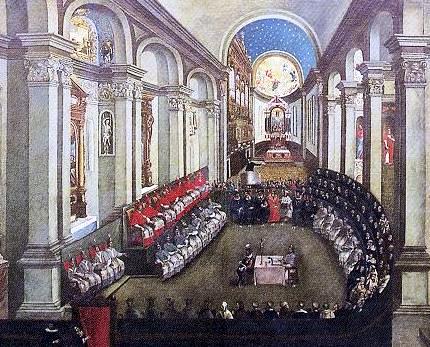
Trent: a renewal


In 1543 the Council of Trent met and Wednesday marked the 450th anniversary of its closure. It is worth noting that the background to the Council is quite similar to the condition of the Church today, there where sexual scandals exemplified by the Borgia, there was partisan careerism exemplified by the Rovera pope, the fearsome warrior Julius II, there were financial scandals, the selling of indulgences by the same pope, there was even a 'gay lobby' on the part of many Curial officials - remember half a century before  'the Greek vice' had been a particular target of Savonarola,

To regard the period before Trent as being a time of doctrinal clarity is to demonstrate both an ignorance of history and to underestimate the importance of the great Council. In England Lollardy had existed since the mid-fourteenth century as an undercurrent, the same in Northern Italy and Switzerland with Waldensians, the great European heresiarchs of  the 16th century built on an already established foundation.

Popes, bishops, priests, abbots, monks along with Emperors, kings and other magnates exploited the faith for their own personal and political advantage. Spurious doctrines tinged with superstition were as common as spurious relics. When heresy reared its head as a new intellectual fashion, the clergy, for the most part, either took it up or because of ignorance were ill equipped to combat it. In Northern Europe principality after principality fell away from the true faith leaving the definitions the Catholic belief ragged and the clergy and faithful demoralised.

If one wishes to understand what was wrong before, or where the Church and it teaching was weak and under attack, it is well worth looking at what Trent saw as important. Its major concern seems to have been the reform of the clergy, not just their intellectual development but their spiritual and moral formation, concubinage, simony, empty benefices, lack of pastoral care, the lack of an evangelical example, seem to have been as much a problem as shaky theology. The new technology of movable type meant that for the first time not only could the Church's theology be made widely available but also its Rites could be standardised with greater ease than with costly manuscripts - it is worth noting that pre-Trent Pontificals were more or less rites peculiar to each diocese. Trent spent a great of time on Justification and Grace because the Medieval theology was imprecise, ultimately giving an imprecise image of God, before moving on to re-write the Rites. The development of the 'Tridentine Mass' is interesting, other Rites were permitted providing they had a 200 year pedigree, which presumably would suggest providing that they were free from nascent Protestantism or exaggerated local preference.

What Trent does with great force is to introduce Thomism into the centre of Catholicism as a unifying force rather than as a possible option, a school of theology amongst other schools. At the most obvious level Trent makes Thomas' definition of Transubstantiation de fidei because previous teaching on the Real Presence was imprecise and open to misreading.

I see liberalism and confusion as being the 'spirit' of Vatican II, Ultramontanism as the 'spirit' of Vatican I. The 'spirit' of Trent is perhaps seeing too harsh a break between the theologies that united East and West before the Great Schism. Trent in many ways marks a Westernisation of Catholicism, as the decline and fall of Constantinople a century before mark the Orientalisation of Orthodoxy. For Catholicism the fruit of the Reformation, because of the Fathers of Trent, was the Glorious Counter-Reformation.

Stephen Beale has a very worthwhile article: Lessons from the Council of Trent:

The achievements of the Counter-Reformation are breathtaking: It gave rise to great religious orders like the Discalced Carmelites, the Capuchins, and the Jesuits, who, in turn launched the great missions to South America, Africa, China and Japan. It gave birth to great saints like St. Teresa of Avila, St. John of the Cross, St. Ignatius of Loyola, St. Philip Neri, and St. Francis de Sales and inspired a new era of devotional fervor, as exemplified in books written by many of those saints, like The Spiritual Exercises and An Introduction to the Devout Life. And it created the form of Catholicism that withstood centuries of social strife and political turmoil, from the French Revolution to the emergence of communism...

The Lord’s descent into the underworld

At Matins/the Office of Readings on Holy Saturday the Church gives us this 'ancient homily', I find it incredibly moving, it is abou...