Wednesday, March 16, 2016

Conscientious Objection

Of note is Fr Simon Henry's post on Holy Thursday foot washing. Father Henry quotes Fr. Joseph Fessio's concerns 'that now the practice is allowed, it will be imposed by some bishops Bishop', a not uncommon phenomena in today's Church. He also quotes Bishop Athanasius Schneider, who says that in conscience he could not wash the feet of women as it would alter Christ's intention of washing the feet of his Apostles rather than anyone's. What the Bishop is concerned about, I suspect is not so much the washing of women's feet but the blurring of a connection with Christ, who chose to wash the feet of those closest to him and who at the Last Supper were entrusted with celebrating the Eucharist and along with it episkope of the Church. I share the Bishop's conscientious objection, others might not, including the Pope, I do,

I interpret St John's language, all that taking off and putting on of vestments as a priestly act meant by the Apostle to remind his readers of the institution of the Aaronic priesthood. I used to wash any foot that turned up but now in conscience I think it would be a denial of what Christ intended and I can't do that. I am grateful I have the freedom to express my conscience. Before the invention of Pius XII the rite happen outside of Mass, and anyone could be involved, within Mass it takes on a Eucharistic meaning.

I have been fortunate, there are many things I do or don't do because of conscience. Though I have used it I really feel uncomfortable about using that trattoria-written-back-of-a menu Eucharistic Prayer (EPII), in fact I have a problem with using one other than the Roman Canon. I don't consider them invalid, just not of the Latin Rite which since the time of St Gregory used this text. They are part of the hermeneutic of rupture, in conscience I don't believe it is possible to be Catholic and to be part of the rupture.
I know it is a bit of a convoluted conscience but it is mine.
I think it is very interesting that Cardinal Sarah felt it necessary to 'clarify' this issue, and to underline my right to be a conscientious objector, Will other Cardinals suggest that there is a conscience clause with regard the issuing of the Holy Father's post - Synod document?
As much as I might welcome conscientious objection I can't help pushing people to the point of making such an objection is the beginning of schism. Yet if bishops and priests do not have a sensitive conscience have they anything to offer?

+++++

An interesting video on the liturgy by CNS in which the scholar Father Jeremy Driscoll OSB, corrects some contemporary liturgical errors.


Tuesday, March 15, 2016

MIT BRENNENDER SORGE

Yesterday was the anniversary Mit brennender Sorge written by Pius XI and smuggled into Germany and read at all Masses in 1937, this letter is anti-Nazi and anti-Hitler.

It calls the German episcopate and Church to oppose Hitler and Nazism, even at the cost of martyrdom.

It is worth reading for what it says to us today when other ideologies that would dethrone Christ, it is also significant as an historical reflection on the ills of Christianity in Germany and its tendency to depart from Christianity and to replace central doctrines with something incredibly dangerous.

Saturday, March 12, 2016

Now we have Mercy


Truth is of the mind, Mercy of the heart.
Truth is an aspiration, Mercy a condescension.
Truth is 'above', Mercy is 'below'.
Truth is narrow, Mercy is broad.
Truth unites, Mercy divides.
Truth is fixed, Mercy is arbitrary.

I have been reading the new revelations from the USA about another bishop and his successor covering up the ongoing abuse of adolescent boys, and elsewhere the present day promotion of clergy that are far from the chaste ideal and steal from their parishes to support a deviant lifestyle. Trying not to be judgemental, trying to see the case for the bishops concerned when they stand before God, I suspect they will plead, "I was being merciful", only to met by the voices of the abused who will cry out to condemn them, "Yes, you were, but not to us".

The problem is 'Mercy' is a rather vague and ambiguous term, we so often hear people speak of 'mercy-killing'. There is always a quality of arbitrariness, even partiality, about it. The concentration camp guard might well claim he was being merciful by beating a prisoner to death with a shovel rather than watching him starve to death. Similarly it might be claimed to be merciful to choose someone to change Vatican light bulbs who charged more and did the job less efficiently, and had a cocaine habit and a depressed wife, who happened to be related to Cardinal S, and therefore their plight was known understood, rather than someone unknown who would do the job more cheaply and efficiently. Under these circumstances Mercy seems likely to be a rather dangerous thing,

Psalm 85 has the beautiful verse:
Mercy and truth have met on the way
Righteousness and peace have embraced.
Mercy when it does not meet truth, really does seem to be  a source of corruption, something to make even a child cry out, 'Its not fair', Without a conscience honed by truth mercy can so easily become an instrument of oppression. Cardinal Kasper sees mercy as the chief attribute of God. For him Jesus Christ is God's Mercy made flesh. Man's redemption comes from God's mercy, not his justice. Of course he is right but Man is not God. Meister Eckhart said, "if we say God is good then we cannot say that man is good, if we say that man is good then we cannot say that God is good", he might well have gone onto say the same about mercy, God's mercy comes from his perfection, in his imperfection man cannot imitate it.
Mercy is a divine attribute, in God's hands it is always arbitrary but it is always good but when it is exercised by fallen human it always tends to corruption.


Back to child abuse: I almost understand that parents might not want to prosecute an abuser of their child, but if they claim they are being merciful, but who are they being merciful to. They are not being merciful to the next victim when the offender goes on to abuse again and again. They are not being merciful even to the abuser if he (or she) then goes on to perform even more serious acts of abuse that might lead to their eternal damnation or even a life spent in prison.

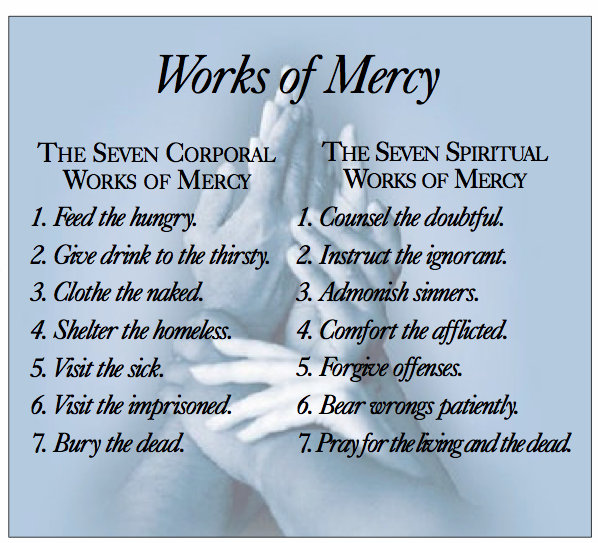
Whilst we might be hard wired to have an understanding of truth, mercy is a little more problematic. It is certainly merciful to feed the hungry, clothe the naked etc,, we can understand that. Scripture tells us that it is an act of mercy to correct the sinner and to teach the ignorant and counsel the doubtful but I do not think that sits well with our current non-judgemental understanding of mercy in the Church.

Mercy tends to confuse. When we talk of truth we tend to have a consensus of what we mean, Mercy however as we saw in the Synod tends to be divisive.

A year ago Bishop Egan said not giving Holy Communion to the pro-abortion politicians was act of mercy, the rest of the Bishop's Conference did not agree and when the Pope praises pro-abortion politicians we might presume he too would oppose the good bishop.

We may either cause or share the guilt of another's sin by praise or flattery, or even silence or by corrupted or even deviant sense of Mercy.

Friday, March 11, 2016

When we had Truth


I have been trying to write something about the nature of  Truth for sometime, I've written hundreds of words and yet failed to be precise, or else it has ended up as a bit of an uncharitable rant.

When Pope Benedict resigned his coat of arms with its motto "Cooperatores Veritatis" was taken down and it seemed that there was a sea-change in the the Church, many seemed to have come to the conclusion being "co-workers of truth" was no longer very important, Nominalism with all the Relativism that Benedict had turned his back on suddenly returned.

Truth was front and centre of the Benedictine pontificate, and along with it a certain intellectual precision and a desire to define precisely what we mean and what the Church believes. This type of precision was always at the heart of Ratzinger's ministry, it was there in his time of Prefect of the CDF. I think a great turning point occurred with his commissioning of Cardinal Schönborn to produce the Catechism of the Catholic Church. I remember speaking to a seminarian who said, "Until the Catechism was published in 1994 we were told any old rubbish was Catholic teaching, then we were able to check for ourselves. It was amazing the effect a copy of it in a seminary class room on even the most way out lecturer". Therefore 1994 became a significant turning point, when 'the faith' was placed in the hands of ordinary Catholics, rather than something which was claimed by 'specialists'. Another great turning point was Dominus Jesus in 2000 which brought precision to our christology and ecclesiology.

Benedict's pontificate was a search for truth that animated countless Catholics, I suspect this was one of the reasons for the rise in numerous Catholic citizen journalists and the flourishing of the Catholic blogosphere. More importantly I believe that it gave rise to a culture for transparency, openness and accountability in the Church. Benedict made it possible for us to ask the simple question, "Is this true?" and to expect an answer, He gave us a point of reference to understand that there were not many truths but one Truth and that this Truth is the Incarnate Word, the 2nd Person of the Holy Trinity, Jesus Christ himself an objective and real presence that should be at the heart of the Church. For Benedict a denial of Truth was a denial of Christ himself, an obfuscation of it an obfuscation of Christ, a lack of clarity about it, a lack of clarity about Christ.

Truth for Benedict  was the disinfecting sun-light, it was the answer to corruption and self-seeking within the Church, as much as it was to false teaching or to obfuscation or a lack of transparency or on a more mundane level bishops covering up child abuse, financial corruption or lobby groups, gay or otherwise, or plain heresy.

The search for Truth seems to have stimulated vocations to the priesthood, it certainly gave an impetus to Catholic intellectual life and the desire of Catholic intellectuals to teach and give ordinary Catholics an intellectual underpinning to their faith.

The idea of Truth being at the heart of the Church or of a Papacy was perhaps incomprehensible to the media as much as it was to Pontius Pilate.
Jesus answered, "You say correctly that I am a king. For this I have been born, and for this I have come into the world, to testify to the truth. Everyone who is on side of the truth hears My voice." Pilate said to Him, "What is truth?" .... John 1: 37-38
Truth is important to the Church, because above all we are called to be convincing witnesses. Liars do not make good witnesses. If in any sense we are found to be untruthful then obviously we lose credibility and so does Christ. To have absolute truth as an aspiration places the Church on a different level to the politician who though he may not exactly tell untruths, manipulates and shades the truth and uses it as tool rather than worshipping it as an icon of God himself.

It is worth reflecting on what Andrea Gagliarducci has written recently and its impact on Truth. What is the point of the Church if we merely have a place at the table and fail to bring the Truth which is Christ?

Monday, March 07, 2016

Fr Montgomery Wright

There is a Newman letter which basically says that the secret of the spiritual life is is getting to bed on time and getting up on time, I know it is true but I don't do it. It has been  my Lenten project.
Last night I saw on Facebook (and I then couldn't find it again there, so sorry for the absence of an accreditation) this rather amazing video about Fr Montgomery Wright.

I've known several people who loved him dearly and experienced his kindness personally. What I think is interesting are the glimpses into his celebration of the Old Rite, he had done it continuously. His celebrations lack the prissiness we have come, post VII, to attach to to it. He adapted it pretty freely to pastoral needs: no choir, he sings, if people didn't know Latin hymns then he let them sing it French.
Well, having seen that this next video came up, it is about a community of Carmelite nuns in their then new convent, it must be at least 60 years old.

Saturday, March 05, 2016

Fr Serafino Lanzetta: Spiritual Combat


Here are two talks by the noted Franciscan theologian Fr Serafino Lanzetta which were given here last Saturday. Our studio's equipment is pretty basic so the sound quality isn't that good but the quality of both talks is, so it is worth making the effort to listen.
Fr Serafino said he wanted to talk about Spiritual Combat but most of the first talk is about Truth and Nominalism, which brings 'Spiritual Combat' down to the most basic theological and philosophical level: Truth must always be exalted and sought, Nominalism must always be opposed!

If you listen to the talks, you will understand why Bishop Egan was so enthusiastic in inviting Fr Serafino into his diocese.

Thursday, March 03, 2016

Things were different then


I have been keeping half an eye on Cardinal Pell's appearances before  Australia’s royal commission into institutional responses into child sexual abuse, after 20 hours of questioning it has now ended. I haven't been watching the on-line video streaming, I have been reading the press reports.

There is an assumption, not just in Australia but elsewhere, including here, that we can judge the past by today's standards and with that there is a an assumption that our attitudes to children has always been what it is today.

Thirty years ago women who were raped simply didn't report it. I remember one woman who did and told me that her experience with the police in the UK was a like second rape. They interrogated her as if she herself was guilty. They wanted to know about her sexual history. They wanted to know the ways in which she might have provoked her assailant, how she was dressed, they even wanted to see her underwear and enquired about why she should want 'sexy' (their word) underwear rather than anything else.

If she had pursued her claim, and the assault had come to trial, in those days she would have had to make her claim in open court, without any reporting restrictions. Her assailant's lawyer would have been able to interrogate her, again revealing her sexual history. In this situation lawyers were aggressive and always shifted the guilt from the man to the women. Newspapers delighted in sexual revelations. For most women rather society than offering sympathy, there was the assumption 'that there is no smoke without fire'. For a 'respectable women' reputations still mattered and a reputation could be easily lost and mark her and her family for the rest of her life. Simply, respectable women did not get raped and respectable people did not know women who were raped,
Now, perhaps the law has changed and many suggest that now an assailant has to prove his innocence but it changed because the law was previously so unfavourable to women.

As with women even more so with children; victims were simply not believed, and sexual abuse was simply not understood. In the Church especially, there was certainly a culture of 'cover-up' this has come under scrutiny but there was also a great deal of sexual naivete on the part of clergy. Many clerics I suspect dealt with their own celibacy by simply trying not to think about sex, by being a-sexual. It was a virtue the result of a spirituality of sexual purity

In the new age of 1960's sexuality Catholic clergy were encountering a new world totally beyond their experience and in many ways at odds with all they believed and were trained in, they were like rabbits in headlights. There was practically no study and very little was written about sexual abuse before the tsunami of accusations that broke in the 1980s in the Catholic Church. The Church had always dealt with such failings by dealing with the perpetrator, it was treated, as everyone says, like alcoholism, as a moral disorder, a spiritual weakness, a breaking of vows. There was a sense that if a period of prayer and reflection didn't work, then often a period as military (or industrial) chaplain might.

In the case of Cardinal Pell surprise was expressed that although he was a Consultor in his home diocese of Ballarat he was oblivious to child abuse in the diocese, I can understand this, I can well imagine that Fr X was discussed but not as a child abuser but in terms of upsetting people and 'various' complaints being received, of being someone who had difficulties with celibacy, even as a malevolent influence on the young but without actually describing what he was doing with children. If the issue was broached at all, like theology manuals of the time it would be couched in the most oblique of terms. The Church of a generation ago tended to see itself as a 'just society' where even the worst of sinners had the right to protection, and where he had the right to have his reputation protected be protected from scandal and certainly if protecting the reputation of the Church was also served.

The Church of course always saw itself as 'merciful', and like every other group in society failed to acknowledge the victims of the pervert's sin. The Church had the problem of not knowing how to deal with its own who had fallen. One consequence has been that bishops in the past saw themselves as fathers of errant sons, now they see themselves as managers with insurance and PR liabilities. I suspect too that there was more than a certain discretion about a matter that was deemed to be more properly dealt with in the internal forum.

What amazes me with the accusations against the Cardinal, and others, is that victims expected the Church to act when they themselves chose not to go the either the police or social services. There was an assumption that somehow the Church had the power to deal with someone that was above or beyond the law. The truth is of course that the social services of the time would have acted in an even less sympathetic way than the Church and the police most probably would have taken no action or treated a child in the same way as they treated women who were raped.

We find it easy to forget that children were treated with what we consider today extraordinary violence. George Ratzinger admitted 'abusing' children in his choir school, he gave them a 'clip round the ear', my music teacher thought little of doing the same. In my own school boys visited the headmaster rarely, few came away without receiving a few strokes of the cane. In the gym there was scarcely a lesson in which a boy was not 'slippered'. It was part of the culture. At Eton at the time, as in most of our more exclusive schools, not only did masters beat but so did senior boys.  In working class families, if a child was beaten at school it would not be unusual for the father to apply the same punishment, "because you must have deserved it". In universities, as in the military, 'hazing' freshman with beatings or even sexual humiliations was part of the culture. Physical and sexual abuse, are obviously not the same but they do tend to go hand in hand, as too of course does psychological abuse. The culture was abusive, and far from child centred. Even in medicine procedures in which an adult might receive anaesthetic children often given to children without it. There was a sense that children get over these things quickly, they have a different pain threshold or they forget quickly.


Cardinal Sodano famously dismissed the clerical sex abuse as media fabrication, perhaps there is some truth in this, perhaps the most politically astute act of Pope Francis was to distance the Papacy by appointing a Commission to deal with it for him, rather than take it on himself. Australian abuse victims are asking for a meeting with him, whether he will grant their request is unlikely, he hasn't met with those who have complained about Cardinal Daneels or the countless victims from Los Angeles who complained about Cardinal Mahony's cover-up and he has been positively dismissive about case brought against the Chilean Bishop Juan Barros who he himself appointed as bishop of Osorno. At best they will be met by Cardinal Sean O'Malley of Boston, head of the papal commission.

The Lord’s descent into the underworld

At Matins/the Office of Readings on Holy Saturday the Church gives us this 'ancient homily', I find it incredibly moving, it is abou...