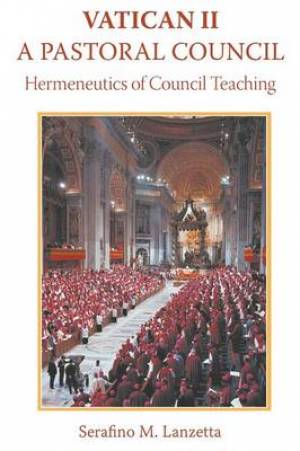
The book aims at clarifying and indicating a possible hermeneutical principle, leading towards a more faithful reception of the Second Vatican Council, which respects the Council in its precise identity and so gives the conciliar teaching its true place in a revealed and defined structure. Hopefully this historical and theological research, involving numerous archive documents, might help looking at Vatican II as a way which will foster unity within the Church.
Wednesday, May 18, 2016
Vatican II: A Pastoral Council, Hermeneutics of Council Teaching
The book aims at clarifying and indicating a possible hermeneutical principle, leading towards a more faithful reception of the Second Vatican Council, which respects the Council in its precise identity and so gives the conciliar teaching its true place in a revealed and defined structure. Hopefully this historical and theological research, involving numerous archive documents, might help looking at Vatican II as a way which will foster unity within the Church.
Sunday, May 15, 2016
Diminution of the Holy Sprit
A thought for discussion:
A real reading of Vatican I gives us a rather beautiful understanding of the role the Pope, it is moderate, it is far from the idea of secular leaders of the 19th or 20th centuries or even our current age, it places the Pope as the servant of the Church, and yet its interpretation, the Spirit of VI produced some of the most inflated, aggrandised Popes ever. Popes who on a whim chose to abolish centuries old Tradition, Popes who saw themselves as innovators, rather than faithful servants who passed on intact what they themselves had received.Whilst this going on there is a movement which at least has the appearance of being against, or to diminish the Holy Spirit, first of all Pius XII abolished the ancient Vigil of Pentecost and Paul VI abolished the Octave of Pentecost. Presumably this was done so as not to overshadow Pius XII's reform of Easter and Holy Week, but I can't help thinking it gave an imbalance to our understanding of the Holy Spirit and therefore our theology as whole.
Paul VI introduces oriental epliclesis into the Rite of Mass - Fr Hunwick has pointed out that in the ancient Eucharistic prayer of the West, the Roman Canon preserves within it a theology of God which is pre-Nicean, the point of being in the Eucharist, at least, almost binaterian . The Eucharist is confected by the Church through the priest offering bread and wine to the Father and he in turn giving us his Son. It is an exchange of gifts and there is no mention of the Holy Spirit in the Eucharistic Prayer, apart from the present doxology at its end. In the East Eucharistic prayers, and the novelty Eucharistic Prayers introduced by Paul VI all, except the earliest, have a calling down of the Spirit.
What has happened is an abandonment in the post-VII of a very Western understanding of God - I wonder if the disorientation this caused has resulted in the rise of the Charismatic movement, a movement where the saving death of Christ is often replaced by a personal, ecstatic or emotional experience of the Spirit. Our Western understanding seems to be that the Holy Spirit is the unseen agent of Holiness, drawing us gradually into a deeper communion with the Father and the Son, within the Church. He is unseen but he is experienced. I think this was very much the understanding prior to Nicea and the later Christological Councils.
What I fear it has brought with it is a sense that the Holy rather than 'welling up' and being 'within' is something which comes down from above. In the day to day experience of Christians it is something from outside. There is a connection here between S Vincent of Lerins, understanding of Catholicism as quod ubique, quod semper, quod ab omnibus creditum est - everwhere, always and by all believed - to what the modern neo-Con might believe, which put crudely, is Catholicism is that which the Pope believes and it is imposed from above on those below. It is the most hideous Ultramontane distortion of the faith, and I suspect it relies on a distortion of the doctrine of the Holy Spirit. Yet it does seem that from VII onwards the role of the Holy Spirit is greatly diminished whilst the significance of the Papacy increases, these two things are surely not unconnected.
Saturday, May 14, 2016
Come Holy Ghost
Octave of Pentecost – I have always regretted that Pope Paul VI
abolished the Octave of Pentecost in the Ordinary Form of Mass, This year, in our Ordo, there
are no feasts during the coming week, so I shall offer votive Masses
of the Holy Spirit throughout the coming week, remembering most especially the Vicar of Christ, and safety of the Church in her mission to teach, with clarity, the nations.
Join me in this petition.
Monday, May 09, 2016
A New Oratory in Bournemouth
It seems as though England is going to have yet another Oratory, this time in Bournemouth, yes another pastoral initiative in the diocese of Portsmouth
From the parish website - A new Oratory in-formation is being inaugurated at Sacred Heart Church in Bournemouth on the 8th of September of this year (2016).
Bishop Philip Egan of Portsmouth has invited Fr Dominic Jacob CO (co-founder of the Oxford Oratory) and Fr Peter Edwards and Fr David Hutton, generously released by the Archbishop of Southwark for this project, to begin an Oratorian Community of St Philip Neri as part of a major evangelisation drive for the diocese.
Fr Peter, Fr Dominic and Fr David will begin their ministry on the feast of Our Lady’s Birthday, at the church which is situated in the heart of Bournemouth, surrounded by students living in university accommodation, many international language schools, diverse ethnic communities, and the homelessness, beside long-standing residents, all within an active town center known its hospitality industry, business and commerce.
In accordance with the charism of their Patron, St Philip Neri, the Oratory in-formation will be devoted to offering sacramental support through daily Mass and confessions, Eucharistic Adoration and formation in the spiritual life, alongside pastoral care of students, the growing number of homeless, others in need, all who make up the local population, and the thousands who pass the doors of Sacred Heart each year.
Bishop Philip Egan of Portsmouth states: “The Diocese has areas of real deprivation and poverty. There are immigrants and foreign nationals from Eastern Europe and overseas, as well as university and college students living far away from home. This is a pastoral situation that is urgent. It impels action.”
Bishop Philip goes on to say, “We need to engage with those who have not yet met the Lord Jesus in Person nor taken to heart the salvation and eternal life He offers. More than ever we need today to be confident and clear in witnessing to the Person of Jesus Christ and the truths of the Catholic faith, in order to help people find the Way to authentic humanism and happiness. This is why I am delighted by this new project beginning at Sacred Heart parish.”
St Philip Neri, Apostle of Rome and Saint of Joy, continues to inspire secular priests today to form communities, without vows, living together in the bond of charity, with the Oratorian charism of prayer, preaching and celebration of the Sacraments, not least in the confessional.
St Philip’s primary apostolate of forming young people in the life of prayer and pastoral care, particularly for the sick and needy, also attracts many by excellence in liturgy and music, through catechesis, and in the New Evangelization through culture and the arts.
This latest Community of St Philip Neri is a Society of Apostolic Life under the direction of the Oratorian Confederation’s Procurator General in Rome for whom the Oxford Oratory and York Oratory-in-Formation have been the formative inspiration.
More information about the Oratory-in-Formation for Sacred Heart Church will be forthcoming in the parish newsletter and on the parish website.
Parishioners and friends of Sacred Heart church are asked to please keep Fr Peter, Fr Dominic and Fr David in their prayers as they prepare for this wonderful apostolate.
Sunday, May 01, 2016
Ages!

Yesterday was the annual St Margaret Clitheroe Procession and Mass in York, it was a nasty wet day, not a day for the best vestments to be out. Attendance was down, so what is interesting is youth of those attending. There are obviously people of all ages but it is the number of younger people that is significant. Here is a link to picture file.
Friday, April 29, 2016
Ken Livingstone's Blind Spot
I can't help thinking Jeremy Corbyn is rather like Pope Francis, trying hold things together but in reality is presiding over its fragmentation, God promises the survival of the Catholic Church but not the Labour party. Corbyn's election like the Pope's was a harking back to a time that many had thought had past, an attempt at popularism. The problem for both is the political environment they now face is not that of their youth.
Watching Ken Livingstone being confronted by John Mann seems to demonstrate how the 'Left' cannot hold. Limestone's defence too is bizarre, "Hitler was a Zionist", he says. It is half remembered and reinterpreted history, seen through a certain lens. Yes, Hitler certainly wanted Jews to have some kind of homeland, many politicians of the time did, suggestion ranged from Palestine, to a bit of Australia, to Madagascar and eventually to 'the East', and history reveals the atrocities that happened there. Hitler's 'Zionism' was borne out of a deep hatred for Jews, and a desire to enslave, and ultimately to destroy them.
I really do not think that Livingstone wants to apply any sanction to 'the Jews', the problem is one of modern intellectuals inability to understand that someone's religious identity, might actually have a social and political dimension. Livingstone's 'anti-Semiticism' is on the same level as his anti-Christianism, more specifically his anti-Catholicism, it is shared by the rest of the Guardian reading establishment. It stems from an inability to realise that a religion has a certain cultural impact that overreaches ordinary politics and claims an affiliation beyond national borders. Religion, politicians on both the left and right fail to understand, binds people together, it has a super-social dimension, it unites people to a history beyond a merely national one, it has a political vision beyond the narrowness of contemporary politics.
For post holocaust Jews the State of Israel has replaced an international Jewish fraternity that followed the diaspora caused of the Roman destruction of Jerusalem in 70 AD. Jews were a distinct group marked not only by belief but by a distinct culture: kosha food and dress, the need to live together and separated from those they lived amongst, and their internationalism and their shared history of persecution make them distinct. The problem is that politicians like Livingstone underestimate the importance of this. In the same way they are incapable of realising the distinctiveness of other groups, like Catholics, whose vision incorporates the social Kingship of Christ.
The blind spot for people like Livingstone is their failure to understand the social, cultural and political significance of Islam. For them Islam merely represents potential Labour votes. Naz Shah whose unguarded pre-election comments started this brush fire for Labour probably do not represent the views of most Muslims but they do represent of some and I would suggest not an insignificant 'some'.
There is an inability of the 'Left' to recognise how distinct the culture of the Judaism makes Jews and also fails to understand how the culture Islam makes Moslem distinct. Livingstone and his ilk believe in assimilation, they cannot recognise that religion makes people distinct. Jews look to Israel, Christians to the Kingdom of Christ and Muslims to the Ummah. The failure to bother to understand and to take seriously the significance of the theology which underlies religious groups at the moment is a catastrophe for the Labour Party and Jeremy Corbyn.
In France, in Belgium, in Germany and through out Europe I am sure that most politicians believe that assimilation will eventually change immigrants but the truth is that religion is actually a much stronger bond than passing political parties, religions endure politics and politicians pass.
Saturday, April 23, 2016
The Dragon is tamed not slain
Dragons exist, do not be deceived!
In the legend of St George the dragon is not slain but wounded and the fair maid once terrified of him ties a cord or a ribbon around his neck and leads him captive into the city.
This is a profound truth in the spiritual life, the dragon is still a dragon, the fair maid, the Christian soul, with the help of the victorious warrior, who is a type of Christ gives us power to subdue something which unchecked can be destructive.
We see this constantly in the conversion of the saints, they don't become different people but virtue takes on a courage and sin is tamed. Saint Peter is an obvious example, I doubt its historic truth but I love the quo vadis legend about Peter, Peter decides to leave Rome during the persecution, meets Christ on the Appian Way and immediately turns back to go to his death., it is so Peter, rash and impetuous always, until the end. It is same with St Francis or Ignatius of the Loyal or countless others, Christ tames the dragon, he is not slain.
Subscribe to:
Posts (Atom)
The Lord’s descent into the underworld
At Matins/the Office of Readings on Holy Saturday the Church gives us this 'ancient homily', I find it incredibly moving, it is abou...
-
Have a look at this post , and this one Yesterday I received an email saying: I need to tell you that your comments have caused widesprea...
-
A French newspaper has reported Pope Francis, once Benedict dies, will abrogate Summorum Pontificum and handover Old Rite's celebrat...
-
After recent happenings I have been thinking I ought to stop blogging. I do not think I have done anything wrong but if journalists, like ...